Cognitive & Neuropeptides

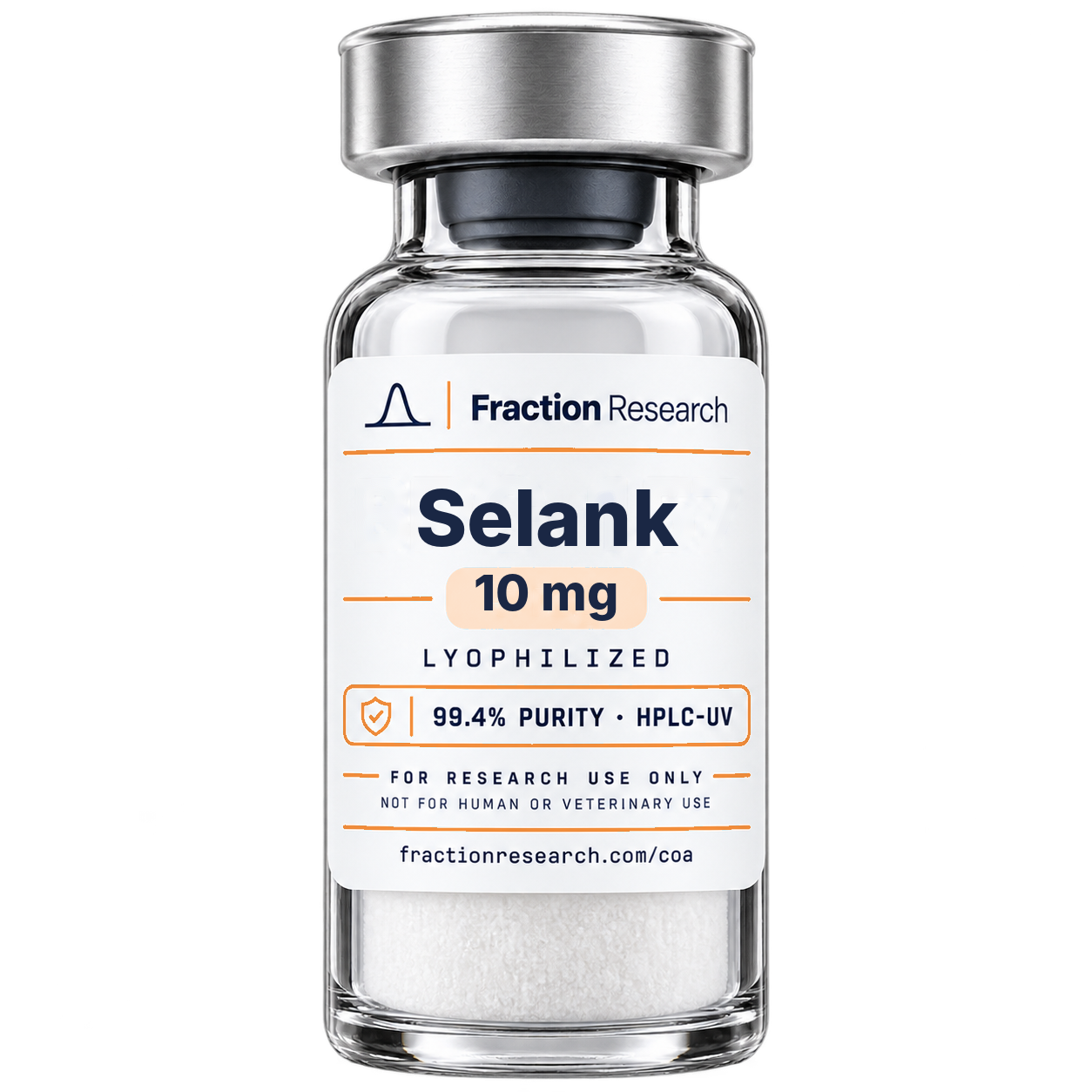
Selank

Price range: $26.99 through $44.99

Current Lot WWB-SK10-3291 verified Mar 15, 2026

Tuftsin-derived anxiolytic heptapeptide

CAS Number
129954-34-3
Molecular Formula
C₃₃H₅₇N₁₁O₉
Molecular Weight
751.86 g/mol
Form
Lyophilized
Purity
≥99% by HPLC-UV
Cold-Packed Protected seasonal packaging
Dispatches ≤48hr From Columbia, SC
Lot Verified COA included with every order
Independently Tested HPLC-UV verified, every single lot
Lot-traceable — matched to a public Certificate of Analysis
Research Use Only — not for human or veterinary use
View Certificate of Analysis

What You Receive

1× Research Vial
  • Selank — nominal content per selected size
  • Lyophilized
  • Tamper-evident seal
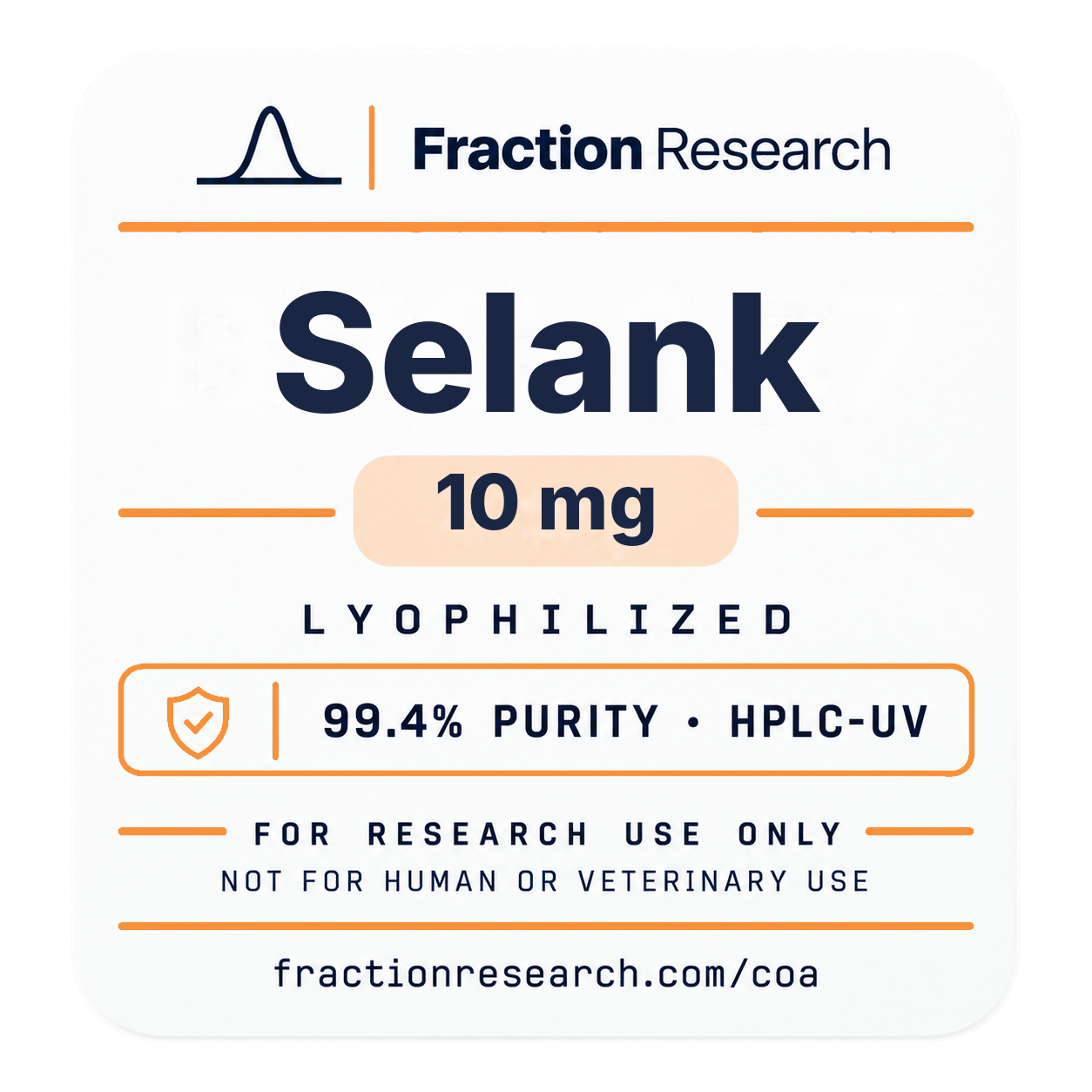
  • Lot-numbered label
  • Lot-matched Certificate of Analysis
Verification

Current Lot & Certificate of Analysis

Lot NumberWWB-SK10-3291
HPLC Purity99.11%
Test DateMar 15, 2026
Testing LaboratoryColmaric Analyticals
Analytical MethodHPLC-UV, 218nm
LC-MS IdentityConfirmed
Specifications

Technical Specifications

CAS Number 129954-34-3
Molecular Formula C₃₃H₅₇N₁₁O₉
Molecular Weight 751.86 g/mol
Physical Form Lyophilized
Purity Specification ≥99% by HPLC-UV
Analytical Method HPLC-UV, 218nm
Appearance Lyophilized research peptide
Storage Conditions Store sealed, protected from moisture and light; minimize temperature cycling
Lot Number WWB-SK10-3291
Batch / Test Date Mar 15, 2026
Research Context

Research Overview

Selank is a synthetic heptapeptide constructed from the tetrapeptide tuftsin, a fragment of the immunoglobulin G heavy chain, extended with a proline-glycine-proline sequence intended to increase stability. It was developed at the Institute of Molecular Genetics in Russia and is studied in the literature primarily as an anxiolytic research compound.

Mechanistic context

The proposed mechanism differs from that of conventional anxiolytics. Rather than acting directly at GABA-A receptors in the manner of benzodiazepines, the published work examines effects on enkephalin-degrading enzymes, with the implication that Selank modulates endogenous opioid peptide availability. A separate line of enquiry concerns brain-derived neurotrophic factor expression. The tuftsin origin also connects the peptide to immunomodulatory activity, though this is less developed in the cited literature.

Published findings

Zozulya and colleagues (2001) reported the inhibitory effect of Selank on enkephalin-degrading enzymes as a possible mechanism of anxiolytic activity — the principal mechanistic proposal in this literature.

Zozulia and colleagues (2008) reported on efficacy and possible mechanisms in the therapy of generalised anxiety disorders and neurasthenia, published in a Russian-language psychiatric journal. Kasian and colleagues (2017) reported that Selank enhanced the effect of diazepam in reducing anxiety under unpredictable chronic mild stress conditions in rats — a combination design that positions the peptide relative to an established comparator rather than against vehicle alone.

Kolik and colleagues (2019) reported protection against ethanol-induced memory impairment in rats, with BDNF content in the hippocampus and prefrontal cortex measured as the proposed mediating variable.

Scope and limitations of the evidence

The Selank literature is concentrated among Russian research institutions, and a portion appears in Russian-language journals. This has practical consequences: peer review conventions, trial registration and reporting standards differ across publishing traditions, and independent replication outside that research community is limited. The 2008 clinical report should be read with these constraints in view.

The rodent work is more accessible to independent evaluation. The unpredictable chronic mild stress model used by Kasian and colleagues is an established paradigm but is known for variable reproducibility across laboratories, which affects the weight any single report can carry.

Use in experimental design

Anxiety-like behaviour in rodents is measured through paradigms — elevated plus maze, open field, light-dark box — that are sensitive to handling, lighting, time of day and prior stress exposure. These should be documented explicitly. Where BDNF is measured as a mediator, the distinction between transcript and mature protein matters, as does brain region, since the Kolik work reports region-specific findings rather than a global change.

Analytical and handling notes

Each lot is supplied with a certificate of analysis reporting RP-HPLC purity, mass identification by ESI-MS and label claim recovery, together with an independent ICP-MS elemental impurities report. Purity figures apply to the specific lot tested and should be read against the lot documentation rather than inferred from generic reference material. Storage guidance appears on the technical data sheet; the exact supplied salt form, counterion and hydration state are lot and supplier specific and should be reconciled against supplier documentation before quantitative work.

This material is supplied for laboratory research use only. It is not a drug, is not intended for human or veterinary use, and no statement above should be read as a claim of therapeutic effect.


References

  1. Zozulia AA, Neznamov GG, Siuniakov TS, et al. Efficacy and possible mechanisms of action of a new peptide anxiolytic Selank in the therapy of generalized anxiety disorders and neurasthenia. Zh Nevrol Psikhiatr Im S S Korsakova. 2008;108(4):38-48. PMID:18454096.
  2. Zozulya AA, Kost NV, Sokolov OYu, et al. The inhibitory effect of Selank on enkephalin-degrading enzymes as a possible mechanism of its anxiolytic activity. Bull Exp Biol Med. 2001;131(4):315-317. doi:10.1023/A:1017979514274.
  3. Kasian A, Kolomin T, Andreeva L, et al. Peptide Selank enhances the effect of diazepam in reducing anxiety in unpredictable chronic mild stress conditions in rats. Behav Neurol. 2017;2017:5091027. doi:10.1155/2017/5091027.
  4. Kolik LG, Nadorova AV, Antipova TA, et al. Selank, peptide analogue of tuftsin, protects against ethanol-induced memory impairment by regulating of BDNF content in the hippocampus and prefrontal cortex in rats. Bull Exp Biol Med. 2019;167(5):641-644. doi:10.1007/s10517-019-04588-9.

Citations are provided for research context only. They describe published work on this compound and are not claims about this product.

Fulfillment

Fulfillment & Packaging

Ships From

Columbia, South Carolina

Dispatch Timeframe

Within 48 hours of order confirmation

Cold-Chain Packaging

Insulated, seasonally adjusted packaging protects material in transit

Tamper-Evident Vial

Every vial ships sealed and lot-labeled

Shipping Area

Domestic (U.S.) shipping only

Shipping Cost

Calculated at checkout — see the Shipping Policy for full details

Questions

Frequently Asked Questions

Is this lot independently tested?

Yes. Every lot is tested by an independent third-party laboratory using HPLC-UV before it is released for sale, and results are published in the COA Library.

How do I locate my lot's Certificate of Analysis?

Use the "View Certificate of Analysis" link on this page, or search the COA Library directly by compound name or the lot number printed on your vial label.

What analytical methods are used?

Purity is determined by HPLC-UV. Molecular identity is confirmed by LC-MS prior to release.

How is the material packaged?

Material ships in a tamper-evident, lot-labeled vial inside cold-chain packaging appropriate for the season.

What does "Research Use Only" mean?

This product is sold exclusively for laboratory and in-vitro research applications by qualified researchers. It is not a drug, dietary supplement, or approved for human or veterinary use.