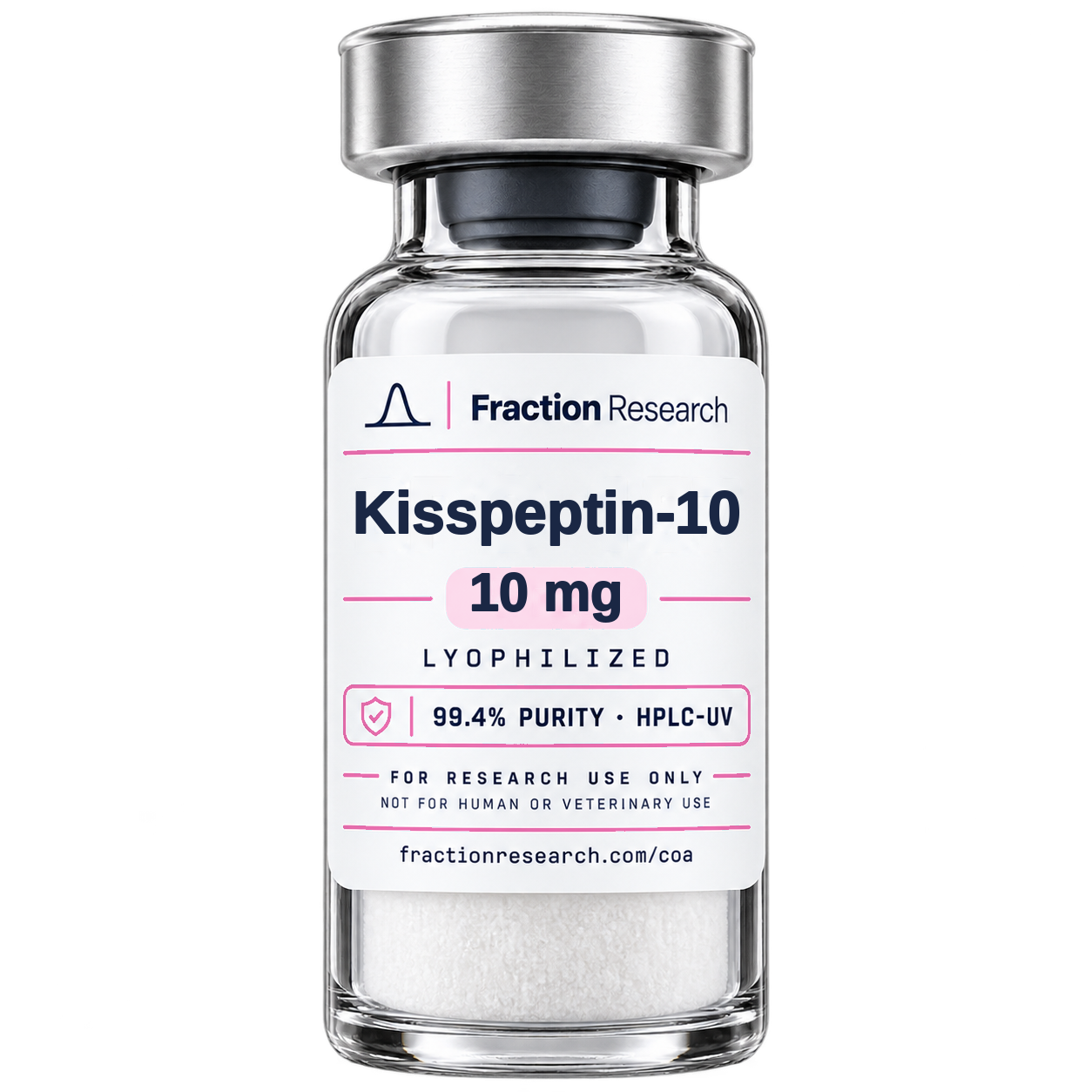
Kisspeptin-10 is a decapeptide fragment of kisspeptin, the product of the KISS1 gene, and functions as an agonist at the KISS1 receptor, formerly designated GPR54. Kisspeptin signalling occupies a well-defined position in reproductive neuroendocrinology as an upstream regulator of gonadotropin-releasing hormone secretion, and this pathway is among the better characterised in the present catalogue.
Mechanistic context
Kisspeptin neurons in the hypothalamus stimulate GnRH release, which in turn drives pituitary secretion of luteinising hormone and follicle-stimulating hormone. Loss-of-function mutations in the KISS1 receptor were identified as a cause of hypogonadotropic hypogonadism, establishing the pathway's necessity for normal reproductive function. Kisspeptin-10 retains receptor activity in a shortened sequence, making it a practical experimental tool for probing the axis.
Published findings
George and colleagues (2011) reported that kisspeptin-10 is a potent stimulator of luteinising hormone and increases pulse frequency in men, providing direct human pharmacodynamic evidence at the level of pulse dynamics rather than mean concentration alone.
Jayasena and colleagues (2011) reported that effects on reproductive hormone release show sexual dimorphism in humans — a finding with direct design implications, since it establishes that results obtained in one sex cannot be assumed to transfer to the other.
Chan and colleagues (2012) examined kisspeptin administration to women as a means of probing endogenous kisspeptin secretion and GnRH responsiveness across the menstrual cycle, using the peptide as an investigative probe of physiology rather than as an intervention. Skorupskaite and colleagues (2016) examined interactions between neurokinin B and kisspeptin in mediating oestrogen feedback in healthy women, addressing the wider regulatory network.
Scope and limitations of the evidence
Unusually for this catalogue, the kisspeptin-10 literature is substantially human and physiological. The studies cited are pharmacodynamic investigations in healthy volunteers, designed to characterise the reproductive axis rather than to establish clinical benefit in any condition, and should be read in those terms.
The sexual dimorphism finding is the most consequential methodological point in this literature. It means sex must be treated as a design variable rather than a covariate, and that pooled analyses across sexes may obscure real effects. The menstrual cycle work further establishes that hormonal phase is a determining variable in female subjects.
Use in experimental design
Because the endpoint of interest is typically pulsatile gonadotropin secretion, sampling frequency governs what a study can detect; the George and colleagues design illustrates the resolution required to characterise pulse frequency rather than amplitude alone. Baseline hormonal status, cycle phase in females, and time of day all require documentation. Kisspeptin-10 is shorter-lived than the full-length peptide, which affects the timing of sampling windows relative to administration.
Analytical and handling notes
Each lot is supplied with a certificate of analysis reporting RP-HPLC purity, mass identification by ESI-MS and label claim recovery, together with an independent ICP-MS elemental impurities report. Purity figures apply to the specific lot tested and should be read against the lot documentation rather than inferred from generic reference material. Storage guidance appears on the technical data sheet; the exact supplied salt form, counterion and hydration state are lot and supplier specific and should be reconciled against supplier documentation before quantitative work.
This material is supplied for laboratory research use only. It is not a drug, is not intended for human or veterinary use, and no statement above should be read as a claim of therapeutic effect.