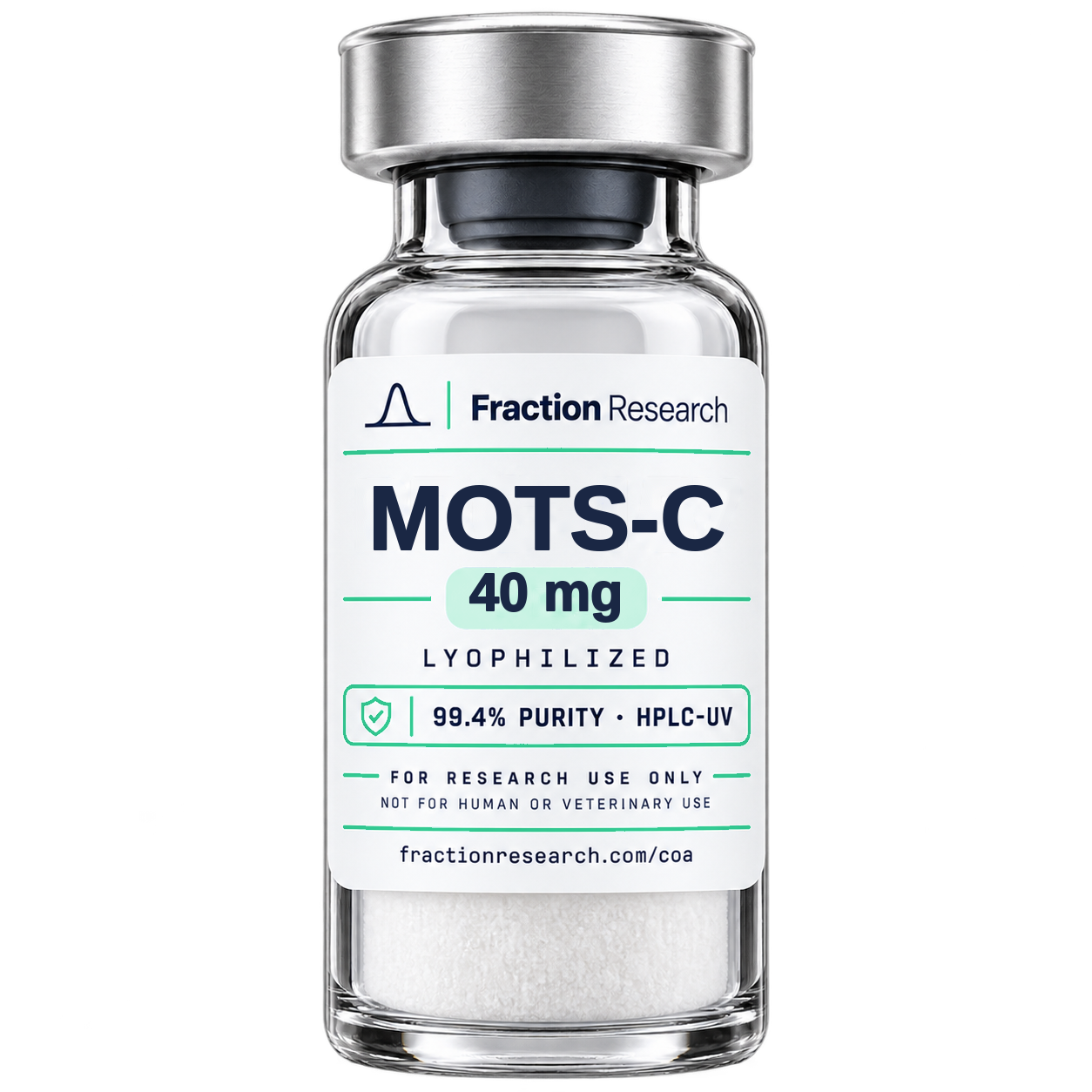
MOTS-c is a sixteen-amino-acid peptide encoded not by nuclear DNA but by the mitochondrial genome, specifically within the 12S rRNA region. It belongs to the class of mitochondrial-derived peptides, and its discovery contributed to the recognition that the mitochondrial genome encodes short bioactive peptides in addition to respiratory chain components.
Mechanistic context
The published work positions MOTS-c within metabolic regulation, with reported effects on the folate cycle and on AMPK signalling — a pathway central to cellular energy sensing. Because the peptide is mitochondrially encoded and appears in circulation, it has been discussed in the literature as a mediator of communication between mitochondria and the rest of the cell, and potentially between tissues. Its measurable presence in human plasma also makes it usable as a biomarker as well as an intervention.
Published findings
Lee and colleagues (2015) reported the original characterisation, describing MOTS-c as promoting metabolic homeostasis and reducing obesity and insulin resistance in mouse models, and identifying the folate cycle and AMPK connection. This is the foundational reference for the peptide.
Ramanjaneya and colleagues (2019) reported that lipids and insulin regulate circulating MOTS-c in polycystic ovary syndrome and in healthy human subjects — an observational study of endogenous peptide levels rather than an administration study, and therefore addressing regulation rather than effect.
Ahn and colleagues (2020) examined effects on mitochondrial function in cells carrying the 3243 A-to-G mutant mitochondrial DNA, a defined pathogenic variant, providing a mechanistically specific cellular model. Von Walden and colleagues (2021) reported that acute endurance exercise stimulates circulating levels of mitochondrial-derived peptides in humans, connecting the peptide to physiological exercise responses.
Scope and limitations of the evidence
The distinction between administration studies and observational studies is unusually important for this compound. The Lee work involves administration in mice; the Ramanjaneya and von Walden human studies measure endogenous circulating levels and do not administer the peptide. Conflating the two overstates what the human literature shows — there is no controlled human administration trial among the cited work.
Circulating peptide measurement is itself methodologically demanding. Assay platforms for mitochondrial-derived peptides differ in specificity, and absolute concentrations reported across studies are not straightforwardly comparable.
Use in experimental design
Because the peptide is mitochondrially encoded, experimental systems with altered mitochondrial content or heteroplasmy — including the mutant cybrid models used by Ahn and colleagues — may respond differently from wild-type systems, and mitochondrial background should be characterised. Where exercise is a variable, the von Walden findings indicate that recent physical activity affects baseline levels, which is a controllable confounder in both animal and human protocols.
Analytical and handling notes
Each lot is supplied with a certificate of analysis reporting RP-HPLC purity, mass identification by ESI-MS and label claim recovery, together with an independent ICP-MS elemental impurities report. Purity figures apply to the specific lot tested and should be read against the lot documentation rather than inferred from generic reference material. Storage guidance appears on the technical data sheet; the exact supplied salt form, counterion and hydration state are lot and supplier specific and should be reconciled against supplier documentation before quantitative work.
This material is supplied for laboratory research use only. It is not a drug, is not intended for human or veterinary use, and no statement above should be read as a claim of therapeutic effect.