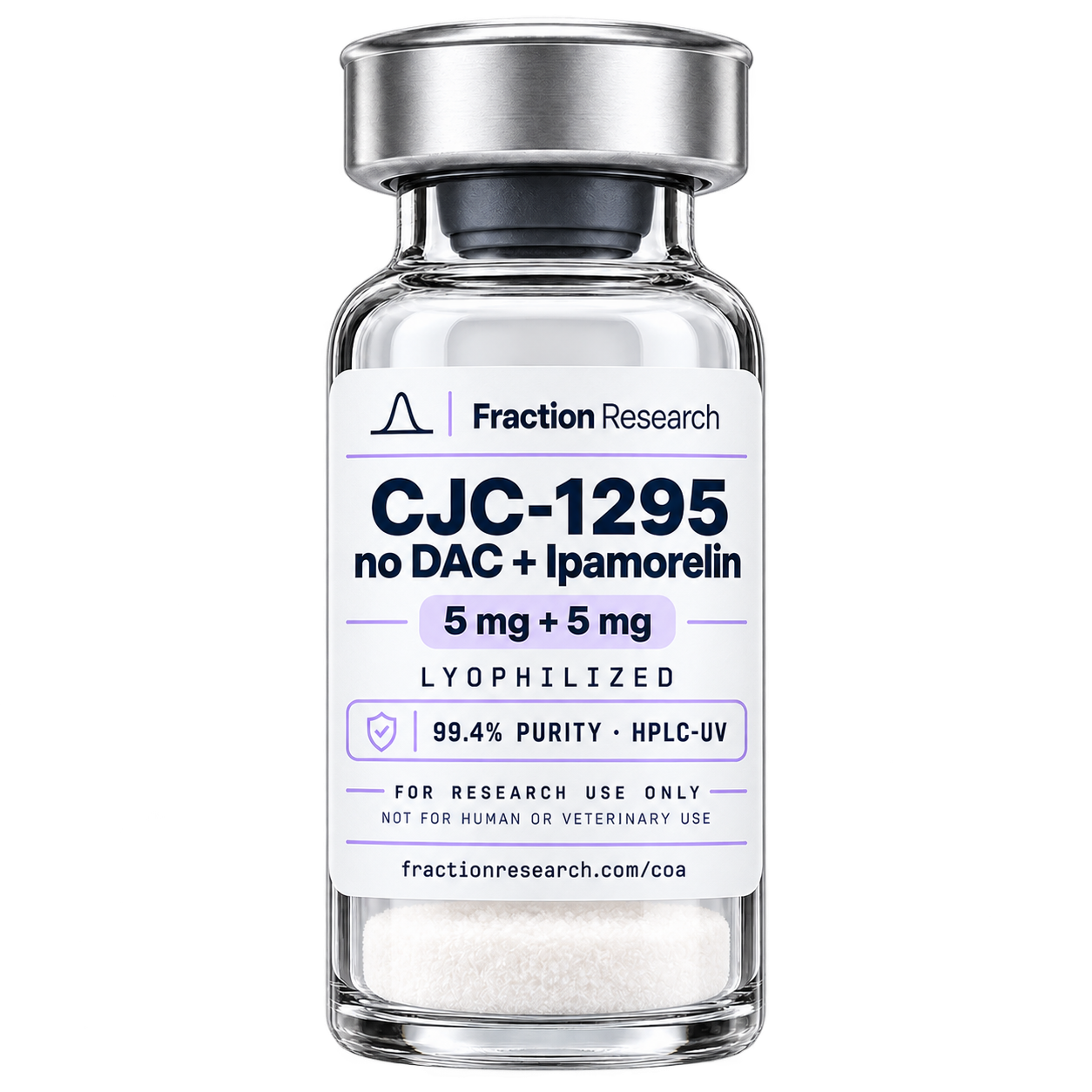
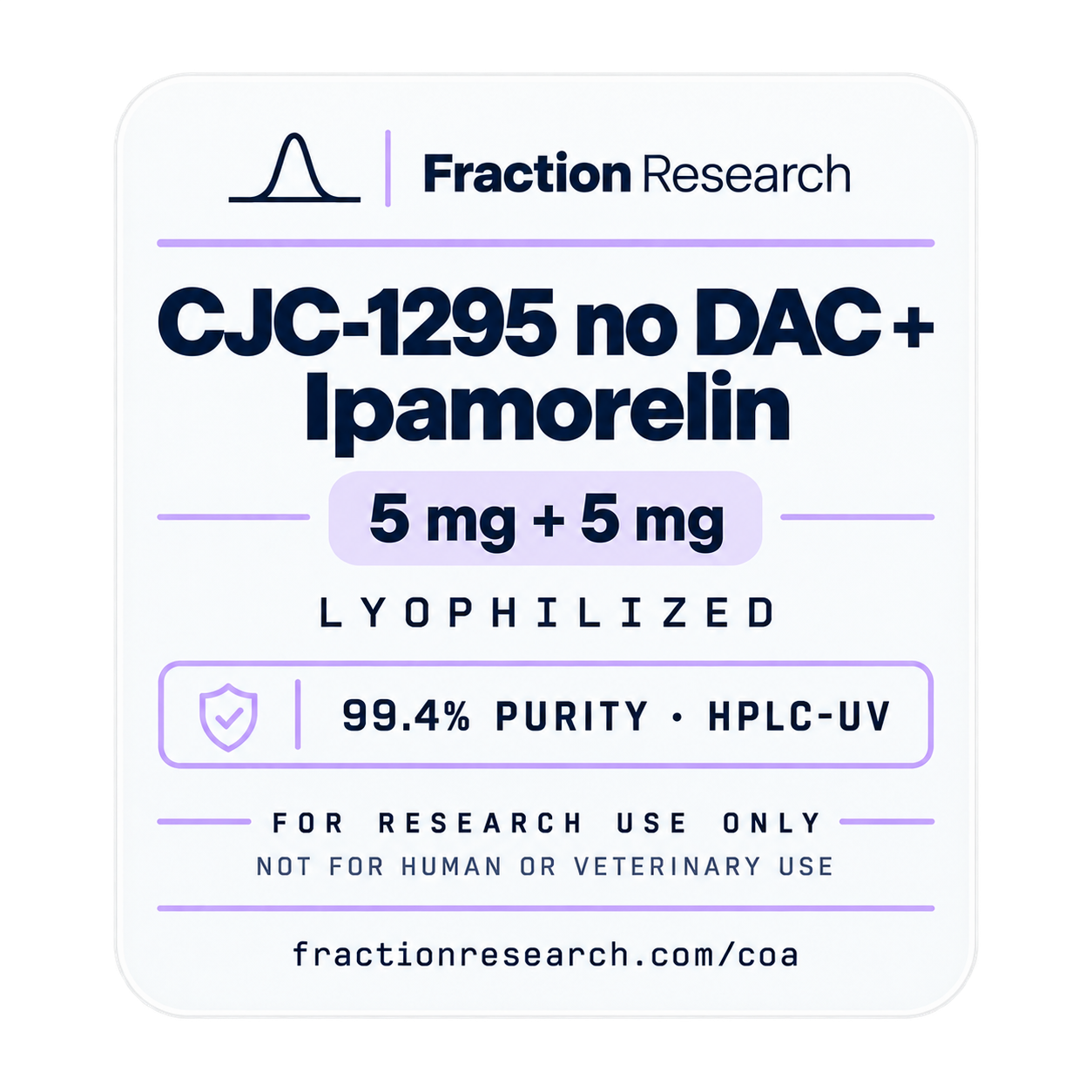
This product is a blend of two distinct research peptides: CJC-1295 without DAC, corresponding to the GHRH(1-29) sequence commonly designated modified GRF(1-29), and ipamorelin, a selective growth hormone secretagogue. The two act on different receptors, and the rationale for combining them rests on the pairing of a growth hormone-releasing hormone analogue with a ghrelin receptor agonist.
Mechanistic context
GHRH(1-29) engages the GHRH receptor on anterior pituitary somatotrophs. Ipamorelin acts at the growth hormone secretagogue receptor, the same receptor engaged by ghrelin, and is characterised in the literature by its selectivity — it stimulates growth hormone release without the appreciable effects on cortisol and prolactin seen with earlier, less selective secretagogues. Because the two peptides engage separate receptors that converge on the same secretory cell, the combination is used in research contexts to examine whether concurrent stimulation of both pathways produces effects distinguishable from either alone.
Published findings — component level
No primary peer-reviewed study evaluates this specific 5 mg + 5 mg commercial blend. The literature below addresses each component individually, and that limitation should be carried into any interpretation.
For the GHRH(1-29) component, Barron and colleagues (1985) reported growth hormone responses to GHRH(1-29)-NH2 and a D-Ala2 analogue in normal men. Neyzi and colleagues (1993) compared growth responses to GHRH(1-29)-NH2 against growth hormone itself.
For ipamorelin, Raun and colleagues (1998) characterised it as the first selective growth hormone secretagogue, establishing the selectivity profile that distinguishes it from earlier compounds in its class. Ankersen and colleagues (1998) reported a series of highly potent growth hormone-releasing peptides derived from ipamorelin, describing the structure-activity work around the scaffold.
Scope and limitations of the evidence
The evidentiary position for this product is weaker than for either component studied alone, and this deserves emphasis. Combination effects cannot be inferred by adding the results of separate single-agent studies: interactions at the level of the somatotroph, receptor desensitisation, and differences in the time course of each peptide all bear on what a combination does, and none of that is addressed in the cited literature.
Nomenclature is a further complication. “CJC-1295 no DAC” is not a consistently standardised name in the academic literature, which more commonly uses modified GRF(1-29) or simply GHRH(1-29)-NH2. Investigators searching the literature under the commercial name will find little; searching under the sequence designation is more productive.
Use in experimental design
Any study of the combination should include single-agent arms if the question concerns interaction rather than combined effect, since without them the design cannot distinguish additive from synergistic or antagonistic outcomes. Because the two peptides are supplied premixed in fixed proportion, the ratio is not an adjustable variable, which constrains dose-response work on either component individually.
Analytical and handling notes
Each lot is supplied with a certificate of analysis reporting RP-HPLC purity, mass identification by ESI-MS and label claim recovery, together with an independent ICP-MS elemental impurities report. Purity figures apply to the specific lot tested and should be read against the lot documentation rather than inferred from generic reference material. Storage guidance appears on the technical data sheet; the exact supplied salt form, counterion and hydration state are lot and supplier specific and should be reconciled against supplier documentation before quantitative work.
This material is supplied for laboratory research use only. It is not a drug, is not intended for human or veterinary use, and no statement above should be read as a claim of therapeutic effect.