Growth Hormone Axis

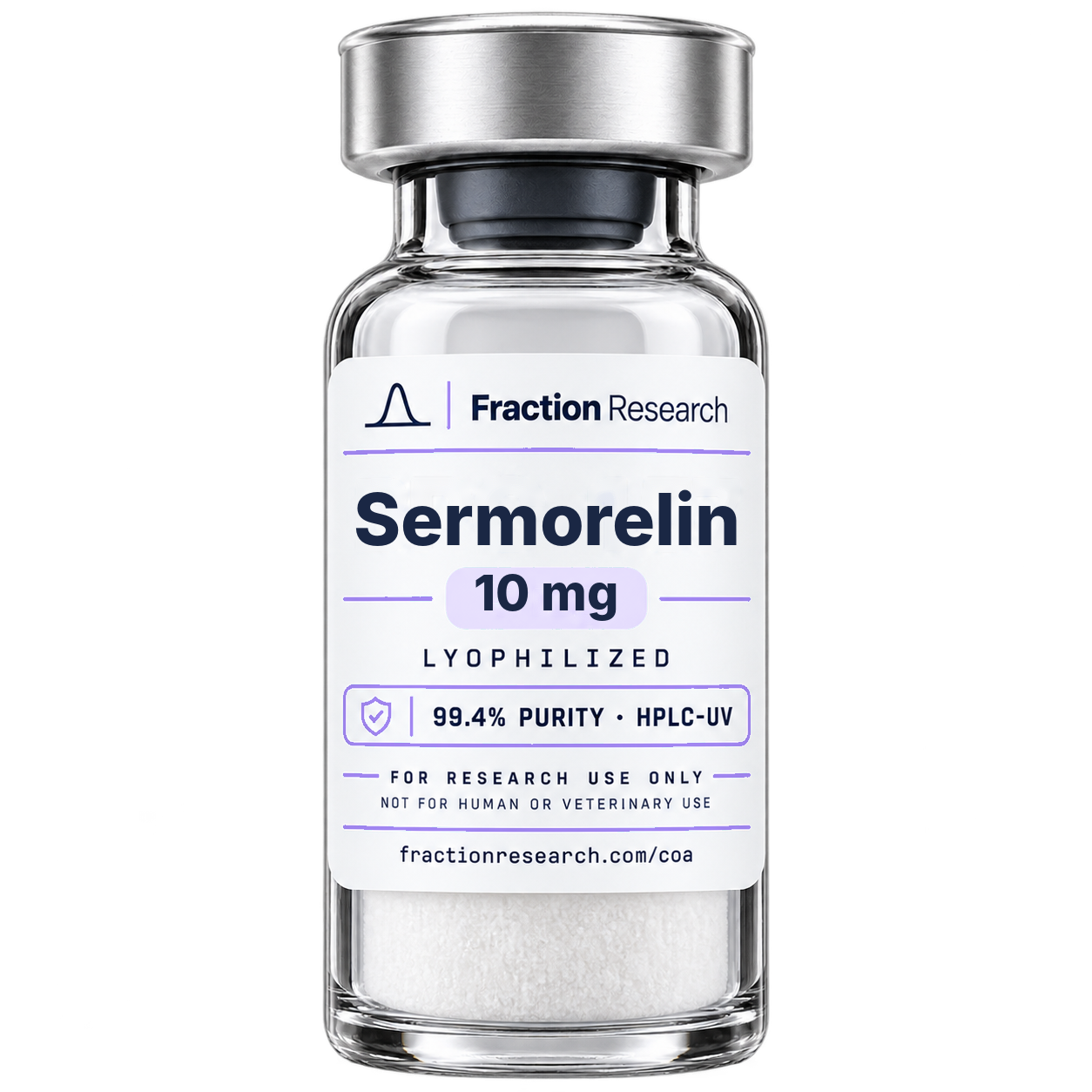
Sermorelin

Price range: $25.99 through $69.99

Current Lot WWB-SM10-4723 verified Mar 26, 2026

GHRH(1-29)-NH₂ fragment

CAS Number
86168-78-7
Molecular Weight
3357.88 g/mol
Form
Lyophilized
Purity
≥99% by HPLC-UV
Cold-Packed Protected seasonal packaging
Dispatches ≤48hr From Columbia, SC
Lot Verified COA included with every order
Independently Tested HPLC-UV verified, every single lot
Lot-traceable — matched to a public Certificate of Analysis
Research Use Only — not for human or veterinary use
View Certificate of Analysis

What You Receive

1× Research Vial
  • Sermorelin — nominal content per selected size
  • Lyophilized
  • Tamper-evident seal
  • Lot-numbered label
  • Lot-matched Certificate of Analysis
Verification

Current Lot & Certificate of Analysis

Lot NumberWWB-SM10-4723
HPLC Purity99.86%
Test DateMar 26, 2026
Testing LaboratoryJanoshik Analytical
Analytical MethodHPLC-UV, 218nm
LC-MS IdentityConfirmed
Specifications

Technical Specifications

CAS Number 86168-78-7
Molecular Weight 3357.88 g/mol
Physical Form Lyophilized
Purity Specification ≥99% by HPLC-UV
Analytical Method HPLC-UV, 218nm
Appearance Lyophilized research peptide
Storage Conditions Store sealed, protected from moisture and light; minimize temperature cycling
Lot Number WWB-SM10-4723
Batch / Test Date Mar 26, 2026
Research Context

Research Overview

Sermorelin is a synthetic peptide corresponding to the first 29 amino acids of growth hormone-releasing hormone, amidated at the C-terminus. This fragment retains the full biological activity of the 44-amino-acid native hormone, which is why GHRH(1-29)-NH₂ became the standard research and clinical form. The published literature typically identifies the compound by that sequence designation rather than by the name sermorelin, a point worth knowing when searching the record.

Mechanistic context

Sermorelin acts at the GHRH receptor on anterior pituitary somatotrophs, stimulating synthesis and release of growth hormone. Because it operates upstream of the pituitary rather than replacing growth hormone directly, secretion remains subject to normal feedback regulation, including somatostatin inhibition. This preserved feedback is the principal mechanistic distinction between GHRH analogues and exogenous growth hormone, and it is the reason the two produce different secretory patterns.

Published findings

Barron and colleagues (1985) reported growth hormone responses to GHRH(1-29)-NH2 and a D-Ala2 analogue in normal men, establishing activity of the truncated fragment in humans and comparing it against a modified analogue.

Ross and colleagues (1990) reported that subcutaneous GHRH augmented pulsatile nocturnal growth hormone release in growth hormone-insufficient children, while also noting that it may raise basal secretion — a finding that distinguishes pulse amplification from baseline elevation, which are physiologically different outcomes.

Neyzi and colleagues (1993) compared growth responses to GHRH(1-29)-NH2 against growth hormone itself, and Chen and colleagues (1993) reported a comparative study of the two for stimulation of growth in children with growth hormone deficiency. Both are direct comparator studies, which makes them more informative than single-arm reports.

Scope and limitations of the evidence

The sermorelin literature includes genuine human clinical work, and the comparator designs against growth hormone are a methodological strength. However, the studies cited are conducted in specific populations — growth hormone-deficient children and normal adult men — and results should not be generalised beyond them.

The literature is also dated, concentrated in the mid-1980s to early 1990s. Assay methodology for growth hormone and IGF-1 has changed substantially since, and absolute values reported in that era are not directly comparable with contemporary measurements.

Use in experimental design

Because the compound acts upstream and preserves feedback, endpoints should distinguish pulse amplitude, pulse frequency and basal concentration — the Ross findings show these can move independently. Frequent sampling is required to resolve them. Nocturnal timing is relevant, since endogenous growth hormone secretion is concentrated in slow-wave sleep and the Ross work specifically examined nocturnal release.

Analytical and handling notes

Each lot is supplied with a certificate of analysis reporting RP-HPLC purity, mass identification by ESI-MS and label claim recovery, together with an independent ICP-MS elemental impurities report. Purity figures apply to the specific lot tested and should be read against the lot documentation rather than inferred from generic reference material. Storage guidance appears on the technical data sheet; the exact supplied salt form, counterion and hydration state are lot and supplier specific and should be reconciled against supplier documentation before quantitative work.

This material is supplied for laboratory research use only. It is not a drug, is not intended for human or veterinary use, and no statement above should be read as a claim of therapeutic effect.


References

The literature typically identifies the active sequence as GHRH(1-29)-NH₂ rather than the name sermorelin.

  1. Barron JL, Coy DH, Millar RP. Growth hormone responses to growth hormone-releasing hormone (1-29)-NH2 and a D-Ala2 analog in normal men. Peptides. 1985;6(3):575-577. doi:10.1016/0196-9781(85)90124-X.
  2. Ross RJ, Kirk JM, Tsagarakis S, et al. Subcutaneous growth hormone-releasing hormone augments pulsatile nocturnal GH release in GH-insufficient children, but may also raise basal GH secretion. Clin Endocrinol (Oxf). 1990;33(2):239-248. doi:10.1111/j.1365-2265.1990.tb00488.x.
  3. Neyzi O, Yordam N, Ocal G, et al. Growth response to growth hormone-releasing hormone(1-29)-NH2 compared with growth hormone. Acta Paediatr Suppl. 1993;388:16-21. doi:10.1111/j.1651-2227.1993.tb12828.x.
  4. Chen RG, Shen YN, Yei J, et al. A comparative study of growth hormone and GH-releasing hormone(1-29)-NH2 for stimulation of growth in children with GH deficiency. Acta Paediatr Suppl. 1993;388:32-35. doi:10.1111/j.1651-2227.1993.tb12834.x.

Citations are provided for research context only. They describe published work on this compound and are not claims about this product.

Fulfillment

Fulfillment & Packaging

Ships From

Columbia, South Carolina

Dispatch Timeframe

Within 48 hours of order confirmation

Cold-Chain Packaging

Insulated, seasonally adjusted packaging protects material in transit

Tamper-Evident Vial

Every vial ships sealed and lot-labeled

Shipping Area

Domestic (U.S.) shipping only

Shipping Cost

Calculated at checkout — see the Shipping Policy for full details

Questions

Frequently Asked Questions

Is this lot independently tested?

Yes. Every lot is tested by an independent third-party laboratory using HPLC-UV before it is released for sale, and results are published in the COA Library.

How do I locate my lot's Certificate of Analysis?

Use the "View Certificate of Analysis" link on this page, or search the COA Library directly by compound name or the lot number printed on your vial label.

What analytical methods are used?

Purity is determined by HPLC-UV. Molecular identity is confirmed by LC-MS prior to release.

How is the material packaged?

Material ships in a tamper-evident, lot-labeled vial inside cold-chain packaging appropriate for the season.

What does "Research Use Only" mean?

This product is sold exclusively for laboratory and in-vitro research applications by qualified researchers. It is not a drug, dietary supplement, or approved for human or veterinary use.