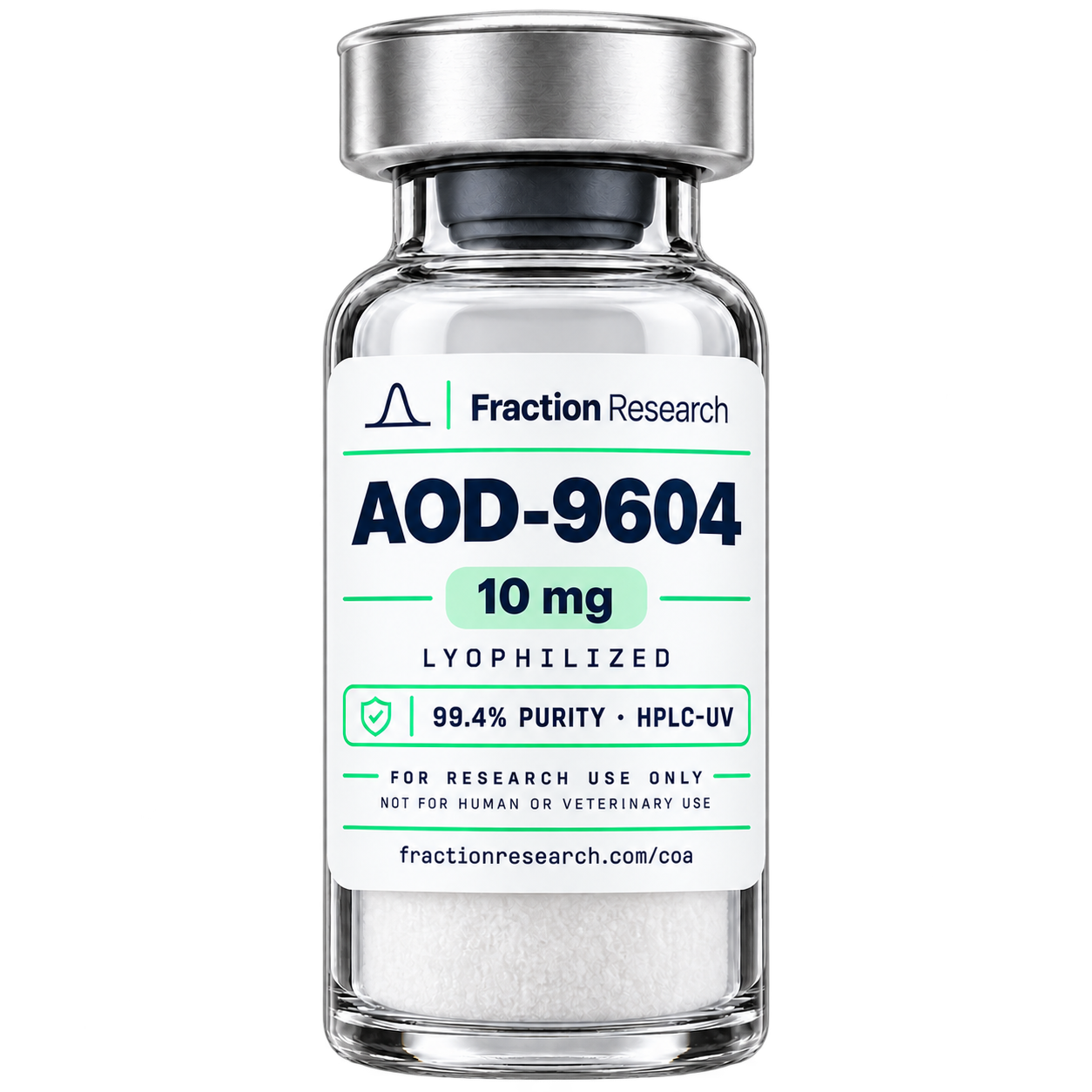
AOD-9604 is a synthetic peptide corresponding to the C-terminal region of human growth hormone, specifically the sequence spanning residues 177 to 191 with an added tyrosine. It was developed to isolate the lipolytic activity attributed to that fragment from the broader hormonal actions of the intact growth hormone molecule, particularly the effects mediated through the growth hormone receptor on growth and insulin sensitivity.
Mechanistic context
The rationale for AOD-9604 rests on early observations that the C-terminal fragment of growth hormone retained effects on lipid metabolism while lacking the growth-promoting activity of the parent hormone. The fragment does not appear to act through classical growth hormone receptor signalling in the manner of full-length hormone, and published work has examined its effects on adipose tissue metabolism in isolation from IGF-1 mediated pathways. The distinction matters experimentally: it allows lipolytic and growth-related endpoints to be separated in study design.
Published findings
Wu and Ng (1993) first characterised the antilipogenic action of the synthetic C-terminal sequence 177-191 of human growth hormone, establishing the fragment as biologically active in its own right. Ng and colleagues (2000) reported metabolic studies of the synthetic lipolytic domain, examining its behaviour relative to the intact hormone.
Heffernan and colleagues (2001) extended this work in vivo, reporting effects of human growth hormone and its lipolytic fragment on lipid metabolism following chronic treatment in obese mice and in β3-adrenergic receptor knockout mice. The knockout arm is mechanistically informative: it was designed to test whether the fragment's metabolic effects depend on β3-adrenergic signalling, a question directly relevant to how the peptide is understood to act.
Cox and colleagues (2015) approached the compound from an analytical direction, reporting detection methods and in vitro metabolism of AOD9604. This work originates from anti-doping science and concerns identification and metabolic fate rather than physiological effect.
Scope and limitations of the evidence
The mechanistic and efficacy literature summarised here is preclinical, drawn from rodent models and in vitro systems. The β3-adrenergic knockout work is a genuine mechanistic contribution, but findings in genetically modified mice do not transfer directly to other species. The analytical literature is the most recent and is concerned with detection rather than function.
Investigators should also note that adipose tissue responses in rodent models are strongly influenced by diet composition, housing temperature and strain background — variables that differ across the studies cited and that complicate direct comparison between them.
Use in experimental design
The value of AOD-9604 in the published record lies in the dissociation it was designed to achieve: it permits lipid metabolism endpoints to be examined without the confounding growth and IGF-1 effects that accompany intact growth hormone. Study designs that exploit this typically include an intact growth hormone comparator arm, as Heffernan and colleagues did, since the interpretive value of the fragment depends on the contrast rather than on its effects in isolation.
Fragment identity is the critical analytical variable for this compound. Because the peptide is defined by its position within a larger hormone sequence, and because the synthetic construct includes an added tyrosine relative to the native 177-191 span, sequence and mass confirmation are more consequential here than for compounds with a single unambiguous name. Investigators should verify the mass identification reported on the lot certificate against the expected value for the construct they intend to study, and should record the exact sequence in any published methods.
Analytical and handling notes
Each lot is supplied with a certificate of analysis reporting RP-HPLC purity, mass identification by ESI-MS and label claim recovery, alongside an independent ICP-MS elemental impurities report. Purity applies to the tested lot only. Because this peptide is a defined fragment of a larger hormone, sequence confirmation is particularly relevant to experimental interpretation, and the mass identification line on the certificate should be checked against the expected value for the intended sequence.
This material is supplied for laboratory research use only. It is not a drug, is not intended for human or veterinary use, and no statement above should be read as a claim of therapeutic effect.