Growth Hormone Axis

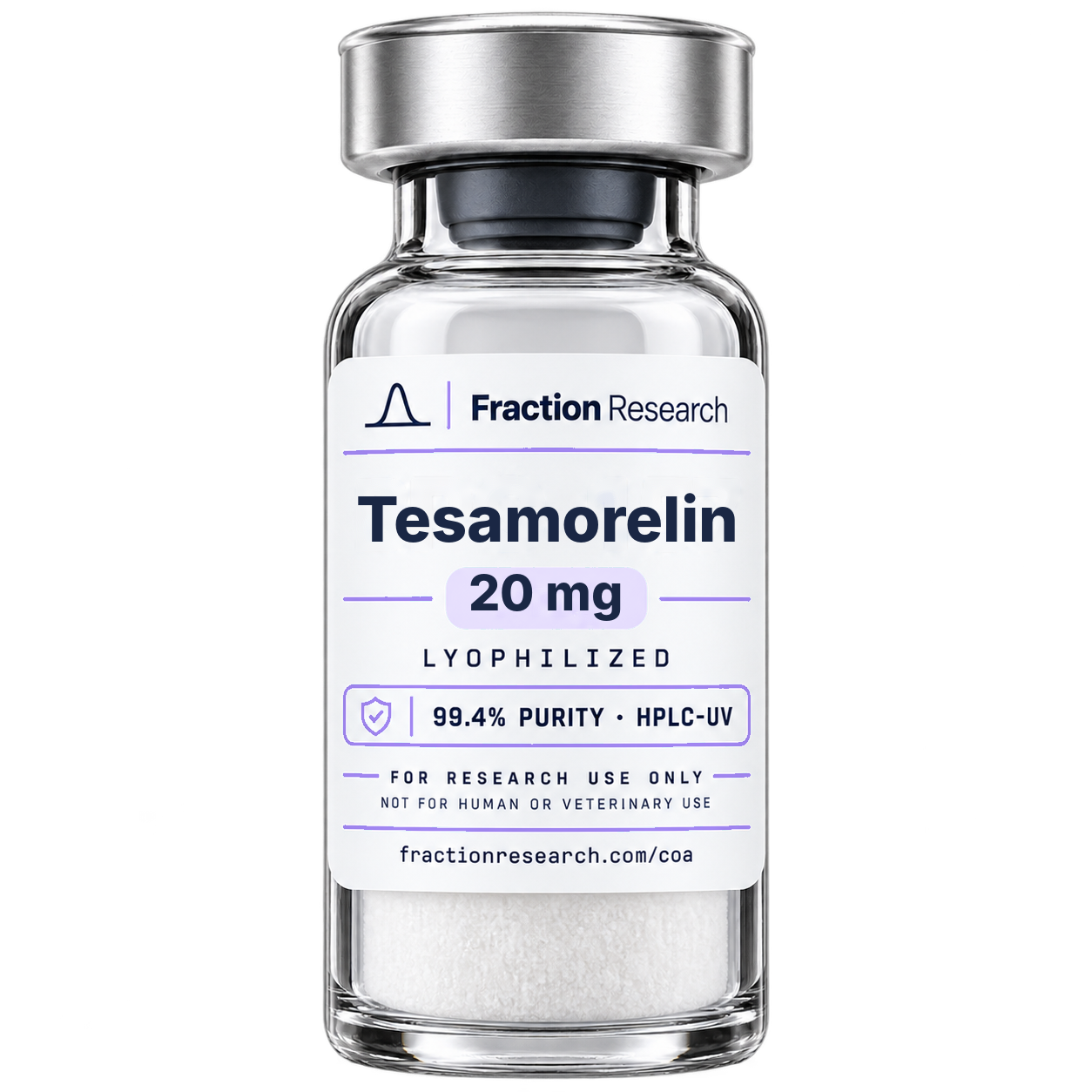
Tesamorelin

Price range: $53.99 through $118.99

Current Lot WWB-TSM20-4532 verified Mar 3, 2026

Full-length GHRH analog with N-terminus modification

CAS Number
218949-48-9
Form
Lyophilized
Purity
≥99% by HPLC-UV
Cold-Packed Protected seasonal packaging
Dispatches ≤48hr From Columbia, SC
Lot Verified COA included with every order
Independently Tested HPLC-UV verified, every single lot
Lot-traceable — matched to a public Certificate of Analysis
Research Use Only — not for human or veterinary use
View Certificate of Analysis

What You Receive

1× Research Vial
  • Tesamorelin — nominal content per selected size
  • Lyophilized
  • Tamper-evident seal
  • Lot-numbered label
  • Lot-matched Certificate of Analysis
Verification

Current Lot & Certificate of Analysis

Lot NumberWWB-TSM20-4532
HPLC Purity98.94%
Test DateMar 3, 2026
Testing LaboratoryColmaric Analyticals
Analytical MethodHPLC-UV, 218nm
LC-MS IdentityConfirmed
Specifications

Technical Specifications

CAS Number 218949-48-9
Physical Form Lyophilized
Purity Specification ≥99% by HPLC-UV
Analytical Method HPLC-UV, 218nm
Appearance Lyophilized research peptide
Storage Conditions Store sealed, protected from moisture and light; minimize temperature cycling
Lot Number WWB-TSM20-4532
Batch / Test Date Mar 3, 2026
Research Context

Research Overview

Tesamorelin is a synthetic analogue of growth hormone-releasing hormone consisting of the GHRH(1-44) sequence with a trans-3-hexenoyl group attached at the N-terminus. The acylation confers resistance to degradation by dipeptidyl peptidase-4, which rapidly inactivates native GHRH, and this stabilisation is the defining structural feature of the compound.

Mechanistic context

Like other GHRH analogues, tesamorelin acts at the GHRH receptor on pituitary somatotrophs to stimulate growth hormone secretion, preserving downstream feedback regulation rather than bypassing it. What distinguishes tesamorelin in the literature is the endpoint on which it was studied: visceral adipose tissue, quantified by imaging rather than inferred from anthropometric measures. This gives its clinical literature an objectivity that self-reported or surrogate endpoints lack.

Published findings

Falutz and colleagues (2007) reported metabolic effects of a growth hormone-releasing factor in patients with HIV in the New England Journal of Medicine, examining visceral fat accumulation in that population. A 2008 report from the same group addressed long-term safety and effects in HIV patients with abdominal fat accumulation, and a 2010 report described a randomised placebo-controlled trial with a safety extension.

Stanley and colleagues (2014) reported effects on visceral fat and liver fat in HIV-infected patients with abdominal fat accumulation, published in JAMA. The inclusion of hepatic fat as an endpoint extends the findings beyond visceral adipose tissue to ectopic fat deposition more broadly.

Scope and limitations of the evidence

Tesamorelin has the most developed clinical literature of any compound in this catalogue: randomised, placebo-controlled trials published in high-profile general medical journals, with imaging-based objective endpoints and reported safety extensions.

The essential limitation is population. All the cited trials were conducted in people with HIV-associated lipodystrophy, a condition with a specific pathophysiology involving antiretroviral therapy and chronic infection. Effects demonstrated in that population do not establish effects in people without it, and this constraint is frequently omitted when the compound is discussed in secondary sources.

Growth hormone axis stimulation also has known effects on glucose metabolism, and the safety extension reports address this. Any evaluation of the literature should include those metabolic findings rather than the adiposity endpoints alone.

Use in experimental design

Visceral adipose tissue quantification requires cross-sectional imaging — CT or MRI at a defined vertebral level — since waist circumference cannot distinguish visceral from subcutaneous compartments. The cited trials establish the methodology. Where glucose metabolism is monitored, fasting measures alone are insufficient to detect the changes GHRH-axis stimulation can produce, and dynamic testing is more informative.

Analytical and handling notes

Each lot is supplied with a certificate of analysis reporting RP-HPLC purity, mass identification by ESI-MS and label claim recovery, together with an independent ICP-MS elemental impurities report. Purity figures apply to the specific lot tested and should be read against the lot documentation rather than inferred from generic reference material. Storage guidance appears on the technical data sheet; the exact supplied salt form, counterion and hydration state are lot and supplier specific and should be reconciled against supplier documentation before quantitative work.

This material is supplied for laboratory research use only. It is not a drug, is not intended for human or veterinary use, and no statement above should be read as a claim of therapeutic effect.


References

  1. Falutz J, Allas S, Blot K, et al. Metabolic effects of a growth hormone-releasing factor in patients with HIV. N Engl J Med. 2007;357(23):2359-2370. doi:10.1056/NEJMoa072375.
  2. Falutz J, Allas S, Mamputu JC, et al. Long-term safety and effects of tesamorelin, a growth hormone-releasing factor analogue, in HIV patients with abdominal fat accumulation. AIDS. 2008;22(14):1719-1728. doi:10.1097/QAD.0b013e32830a5058.
  3. Falutz J, Potvin D, Mamputu JC, et al. Effects of tesamorelin, a growth hormone-releasing factor, in HIV-infected patients with abdominal fat accumulation: a randomized placebo-controlled trial with a safety extension. J Acquir Immune Defic Syndr. 2010;53(3):311-322. doi:10.1097/QAI.0b013e3181cbdaff.
  4. Stanley TL, Feldpausch MN, Oh J, et al. Effect of tesamorelin on visceral fat and liver fat in HIV-infected patients with abdominal fat accumulation: a randomized clinical trial. JAMA. 2014;312(4):380-389. doi:10.1001/jama.2014.8334.

Citations are provided for research context only. They describe published work on this compound and are not claims about this product.

Fulfillment

Fulfillment & Packaging

Ships From

Columbia, South Carolina

Dispatch Timeframe

Within 48 hours of order confirmation

Cold-Chain Packaging

Insulated, seasonally adjusted packaging protects material in transit

Tamper-Evident Vial

Every vial ships sealed and lot-labeled

Shipping Area

Domestic (U.S.) shipping only

Shipping Cost

Calculated at checkout — see the Shipping Policy for full details

Questions

Frequently Asked Questions

Is this lot independently tested?

Yes. Every lot is tested by an independent third-party laboratory using HPLC-UV before it is released for sale, and results are published in the COA Library.

How do I locate my lot's Certificate of Analysis?

Use the "View Certificate of Analysis" link on this page, or search the COA Library directly by compound name or the lot number printed on your vial label.

What analytical methods are used?

Purity is determined by HPLC-UV. Molecular identity is confirmed by LC-MS prior to release.

How is the material packaged?

Material ships in a tamper-evident, lot-labeled vial inside cold-chain packaging appropriate for the season.

What does "Research Use Only" mean?

This product is sold exclusively for laboratory and in-vitro research applications by qualified researchers. It is not a drug, dietary supplement, or approved for human or veterinary use.