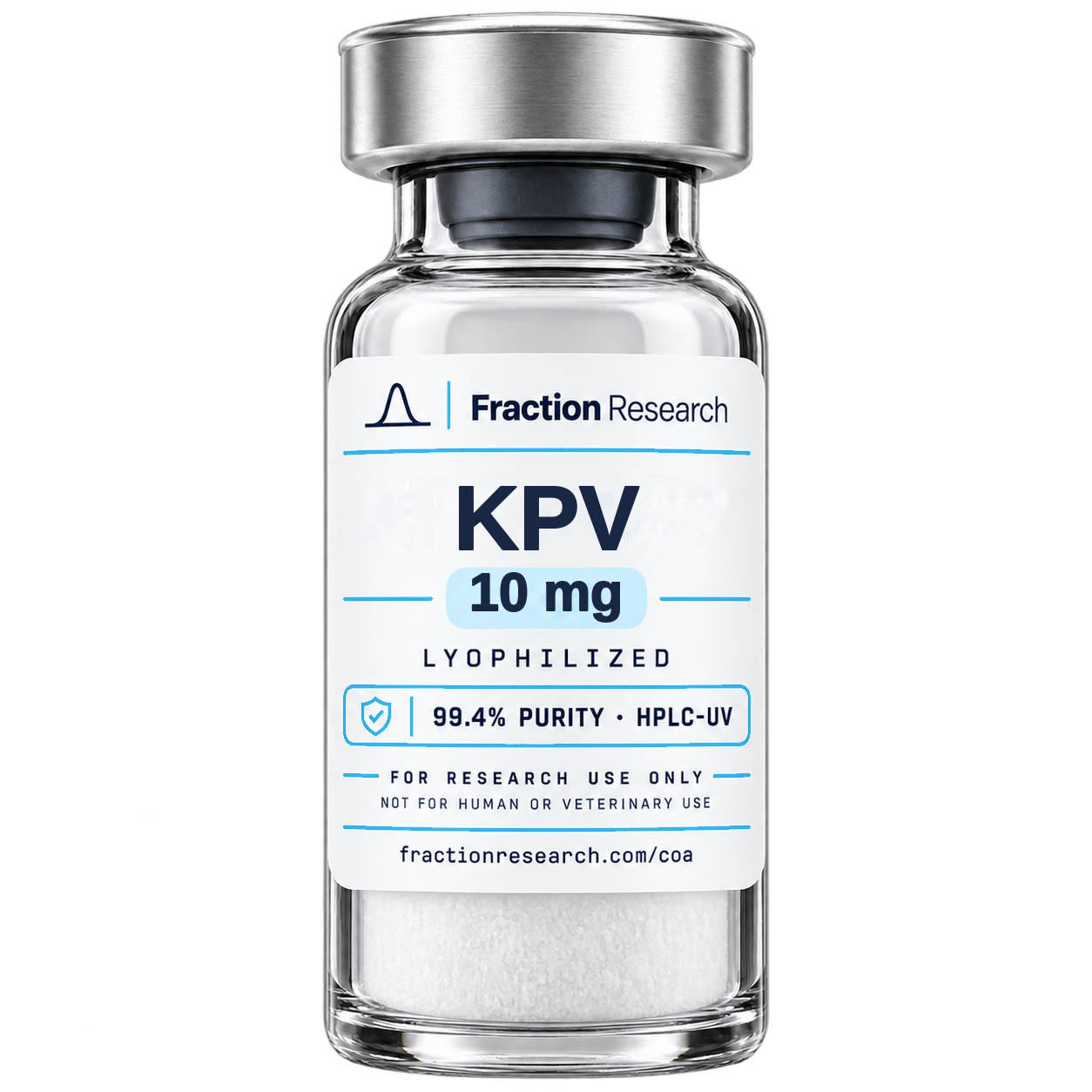
KPV is a tripeptide consisting of lysine, proline and valine, corresponding to the C-terminal 11-13 sequence of alpha-melanocyte-stimulating hormone. Despite its very small size it retains anti-inflammatory activity attributed to the parent hormone in the published literature, and this dissociation of activity from the full sequence is the reason it has been studied as a distinct entity.
Mechanistic context
Alpha-MSH is a melanocortin peptide with established anti-inflammatory properties alongside its pigmentary actions. The published work on KPV examines whether the tripeptide fragment retains the anti-inflammatory component, and by what route it reaches its site of action. A notable line of enquiry concerns PepT1, an intestinal peptide transporter, as a mechanism of cellular uptake — a transport-mediated route that is unusual among the compounds in this catalogue and directly relevant to intestinal models.
Published findings
Elliott and colleagues (2004) examined alpha-MSH, the MSH 11-13 KPV fragment and adrenocorticotropic hormone signalling in human keratinocyte cells, situating the tripeptide within melanocortin signalling in a human cell system.
Dalmasso and colleagues (2008) reported that PepT1-mediated tripeptide KPV uptake reduces intestinal inflammation, linking a specific transport mechanism to a functional anti-inflammatory outcome. In the same year Kannengiesser and colleagues (2008) reported anti-inflammatory potential in murine models of inflammatory bowel disease, providing in vivo support in established disease models.
Laroui and colleagues (2010) reported on drug-loaded nanoparticles targeted to the colon with a polysaccharide hydrogel reducing colitis in a mouse model — a formulation and delivery study rather than an investigation of the peptide's intrinsic activity, and it should be read as such.
Scope and limitations of the evidence
The KPV literature is preclinical, comprising murine colitis models and human cell culture work. The murine models used — chemically induced and genetically driven colitis systems — are established tools but reproduce only aspects of human inflammatory bowel disease, and effects observed in them have historically translated inconsistently.
The Laroui study is worth distinguishing carefully: because it examines a nanoparticle delivery system, its results speak to the combined performance of formulation and peptide rather than to KPV alone. Conclusions about the tripeptide drawn from that paper require care.
Use in experimental design
The PepT1 transport mechanism has a direct experimental consequence: uptake depends on transporter expression, which varies by tissue, by cell line and by inflammatory state. Studies should verify transporter expression in the chosen system rather than assume it. Where colitis models are used, disease induction protocol, scoring system and baseline microbiota all influence outcomes and differ across the cited work, which limits direct comparison between reports.
Analytical and handling notes
Each lot is supplied with a certificate of analysis reporting RP-HPLC purity, mass identification by ESI-MS and label claim recovery, together with an independent ICP-MS elemental impurities report. Purity figures apply to the specific lot tested and should be read against the lot documentation rather than inferred from generic reference material. Storage guidance appears on the technical data sheet; the exact supplied salt form, counterion and hydration state are lot and supplier specific and should be reconciled against supplier documentation before quantitative work.
This material is supplied for laboratory research use only. It is not a drug, is not intended for human or veterinary use, and no statement above should be read as a claim of therapeutic effect.