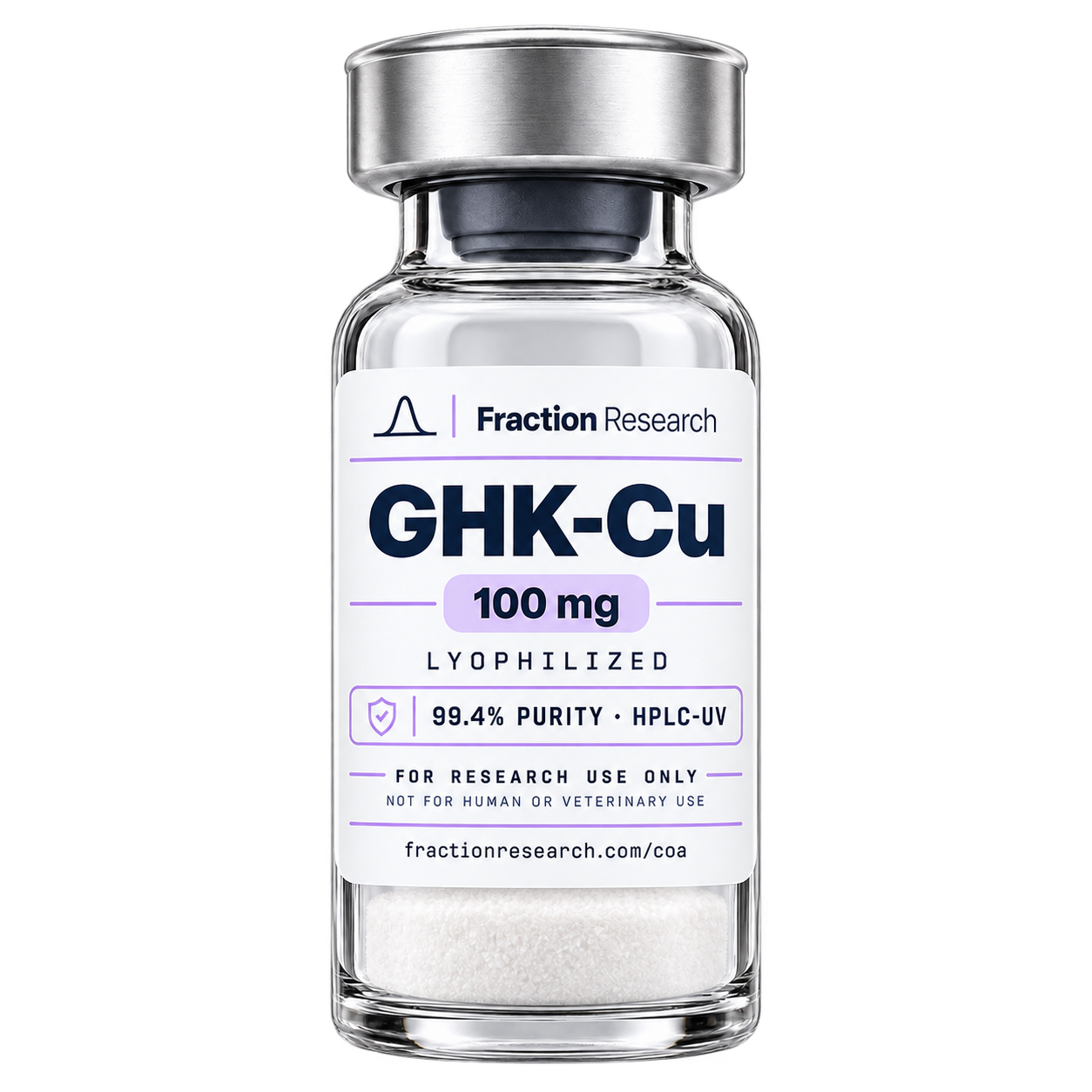
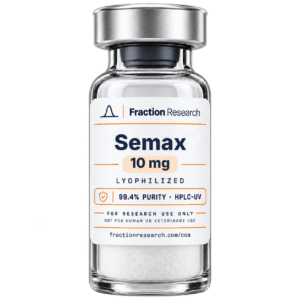
GHK-Cu is a copper peptide complex formed between the tripeptide glycyl-L-histidyl-L-lysine and a copper(II) ion. It is not a peptide alone but a defined metal-peptide complex, and the copper is integral to the activity described in the literature rather than incidental to it. The tripeptide was originally identified in human plasma, with subsequent work establishing its high affinity for copper(II).
Mechanistic context
The published mechanistic work concerns extracellular matrix biology. GHK-Cu has been studied for effects on collagen synthesis, glycosaminoglycan production and matrix metalloproteinase expression in fibroblast systems — that is, on both the synthesis and the controlled degradation arms of matrix turnover. The copper ion is understood in this literature to be functionally necessary, and the complex is generally studied as such rather than as the free tripeptide.
Published findings
Maquart and colleagues (1988) reported stimulation of collagen synthesis in fibroblast cultures by the tripeptide-copper complex, establishing the principal finding on which subsequent work builds. Wegrowski and colleagues (1992) extended this to sulfated glycosaminoglycan synthesis, broadening the matrix synthesis picture beyond collagen alone.
Siméon and colleagues (2000) reported that the complex stimulated matrix metalloproteinase-2 expression in fibroblast cultures. This is an important counterpoint to the synthesis findings: it indicates effects on matrix remodelling in both directions, which is a more nuanced picture than synthesis stimulation alone.
Pollard and colleagues (2005) examined effects on the growth and expression of growth factors by normal and irradiated fibroblasts, introducing a stressed-cell comparison alongside normal cells.
Scope and limitations of the evidence
This literature is predominantly in vitro, conducted in cultured fibroblast systems. Fibroblasts in culture behave differently from fibroblasts in intact tissue — they lack the three-dimensional matrix context, the mechanical loading and the immune cell interactions that shape matrix turnover in vivo — and results should not be extrapolated across that gap without caution.
A specific analytical consideration applies to this compound that does not apply to the peptides in this catalogue. Because activity depends on the copper complex, both the peptide identity and the copper stoichiometry are relevant to experimental interpretation. Free copper ions have biological effects of their own, and study designs should distinguish complex-mediated effects from those attributable to copper alone, ideally with appropriate copper-salt controls.
Use in experimental design
Copper speciation in culture medium is affected by medium composition, serum content and pH, all of which influence the stability of the complex. These conditions should be documented. Where matrix endpoints are measured, the distinction between transcript-level and protein-level measurement matters, since the cited literature includes both and they do not always agree.
Analytical and handling notes
Each lot is supplied with a certificate of analysis reporting RP-HPLC purity, mass identification and label claim recovery, together with an independent ICP-MS elemental impurities report. The elemental report is of particular relevance for a copper complex, since it characterises the elemental impurity profile against ICH Q3D limits — noting that the copper present as part of the intended complex is a constituent of the material rather than an impurity. Storage guidance appears on the technical data sheet, which describes this material as a lyophilised copper-peptide research material.
This material is supplied for laboratory research use only. It is not a drug, is not intended for human or veterinary use, and no statement above should be read as a claim of therapeutic effect.