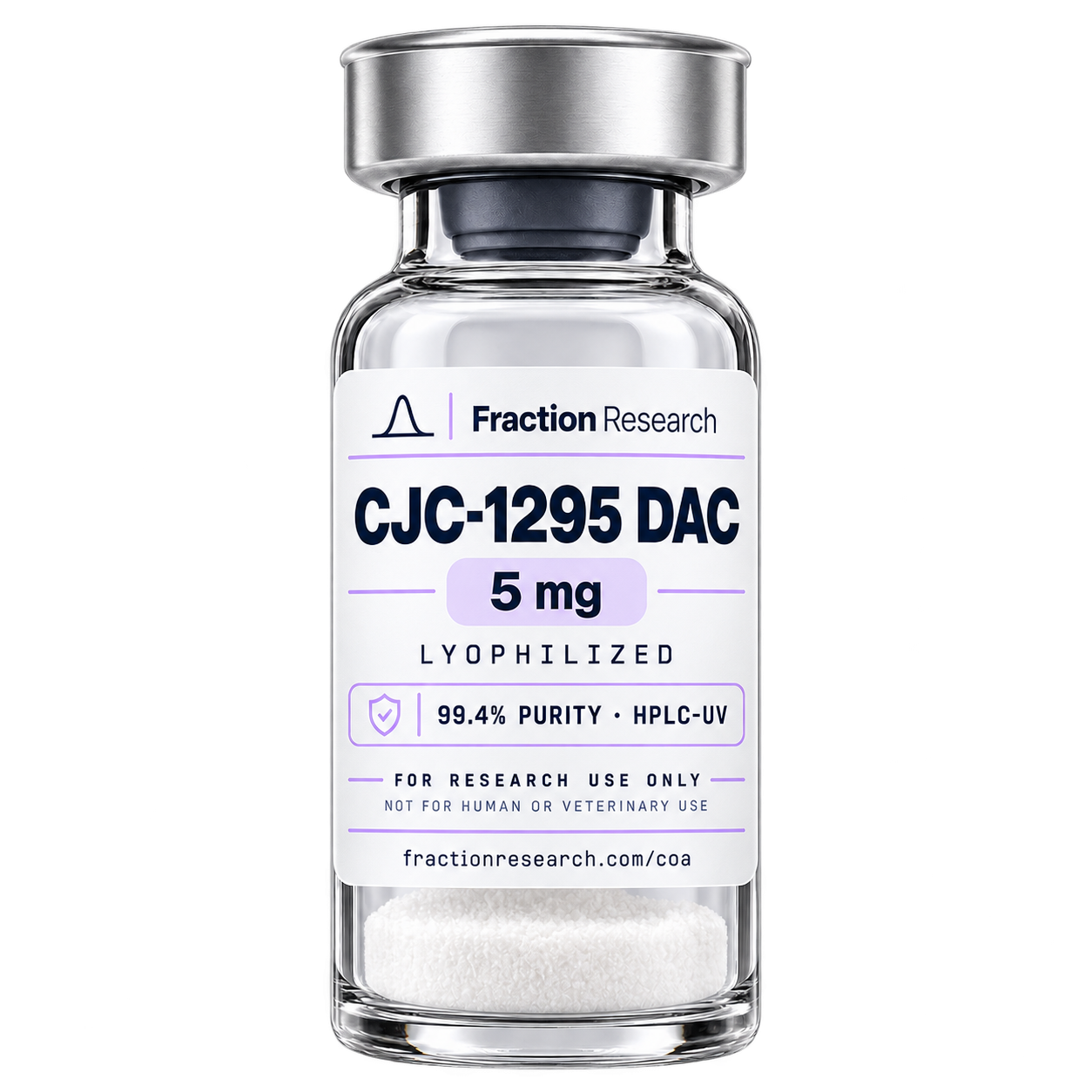
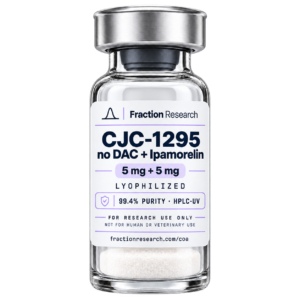
CJC-1295 with DAC is a synthetic analogue of growth hormone-releasing hormone based on the GHRH(1-29) sequence, modified with a drug affinity complex — the DAC element — that enables covalent binding to circulating albumin. The albumin conjugation is the defining feature of this construct and the reason it is treated separately in the literature from GHRH analogues lacking that modification.
Mechanistic context
Native GHRH has a very short circulating half-life, limiting its utility as a research tool for studying sustained somatotroph stimulation. The DAC modification was designed to extend exposure by forming a bioconjugate with serum albumin, producing prolonged receptor engagement from a single administration. The mechanistic question this raises — whether continuous stimulation of the GHRH receptor abolishes the pulsatile pattern of growth hormone secretion — is directly addressed in the published work and is the most scientifically interesting aspect of the compound.
Published findings
Jetté and colleagues (2005) characterised hGRF(1-29)-albumin bioconjugates, demonstrating activation of the GRF receptor on the anterior pituitary in rats and identifying CJC-1295 as a long-lasting GRF analogue. This paper establishes both the conjugation chemistry and the receptor-level activity.
Teichman and colleagues (2006) reported prolonged stimulation of growth hormone and IGF-1 secretion in healthy adults, providing human pharmacodynamic data. Alba and colleagues (2006) reported that once-daily administration normalised growth in the GHRH knockout mouse — a genetic model in which the endogenous ligand is absent, making it a stringent test of the analogue's receptor activity.
Ionescu and Frohman (2006) addressed the pulsatility question directly, reporting that pulsatile growth hormone secretion persisted during continuous stimulation. This finding is mechanistically significant because it indicates that the pulse generator operates downstream of, or independently from, continuous GHRH receptor occupancy.
Scope and limitations of the evidence
This compound has a stronger literature base than most in this catalogue, including human pharmacodynamic data and a genetic knockout model. The human work by Teichman and colleagues examined hormone secretion endpoints in healthy adults rather than clinical outcomes, and should be read as pharmacodynamic characterisation rather than as evidence of therapeutic benefit.
Investigators should be careful with nomenclature. The name CJC-1295 is used in commercial contexts for both the DAC-modified conjugate and for unmodified GHRH(1-29), which have substantially different exposure profiles. The literature cited here concerns the DAC-modified construct specifically, and results do not transfer to the unmodified peptide.
Use in experimental design
Because the albumin conjugation extends exposure considerably, study designs must account for accumulation across repeated administration and for the long washout that follows. Sampling schedules built around short-acting secretagogues will not capture the relevant kinetics. Where growth hormone pulsatility is an endpoint, frequent sampling is required — the Ionescu and Frohman design illustrates the resolution needed to detect pulses against a continuously stimulated baseline.
Analytical and handling notes
Each lot is supplied with a certificate of analysis reporting RP-HPLC purity, mass identification by ESI-MS and label claim recovery, together with an independent ICP-MS elemental impurities report. Purity figures apply to the specific lot tested and should be read against the lot documentation rather than inferred from generic reference material. Storage guidance appears on the technical data sheet; the exact supplied salt form, counterion and hydration state are lot and supplier specific and should be reconciled against supplier documentation before quantitative work.
This material is supplied for laboratory research use only. It is not a drug, is not intended for human or veterinary use, and no statement above should be read as a claim of therapeutic effect.