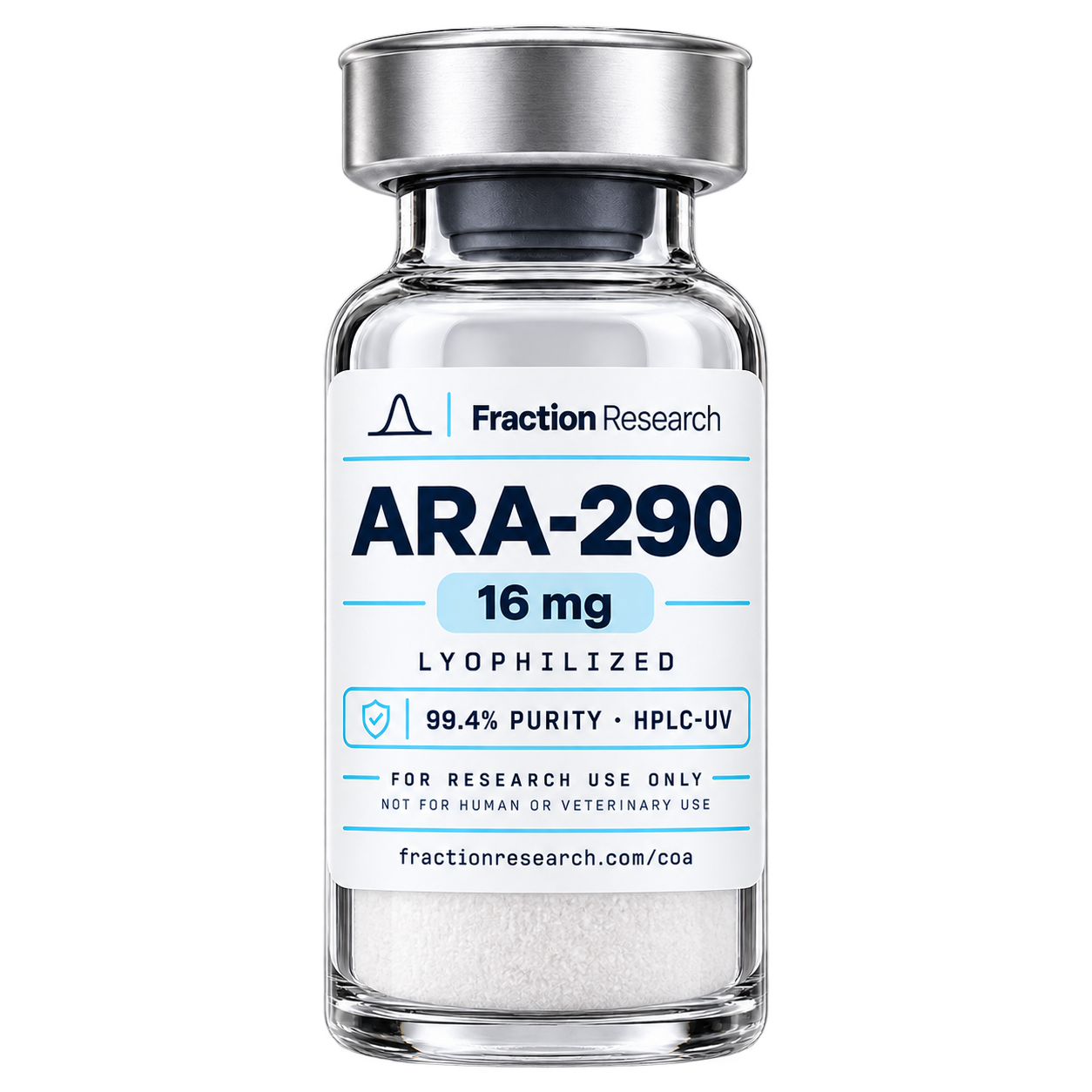
ARA-290, also referred to as cibinetide in parts of the literature, is an eleven-amino-acid peptide engineered from the tertiary structure of erythropoietin. It was designed to reproduce the tissue-protective signalling attributed to erythropoietin while omitting the haematopoietic activity that defines the parent hormone's principal action. This separation is the compound's central design premise and the reason it appears in the literature as a tool for studying tissue protection independently of red cell production.
Mechanistic context
Erythropoietin signals through the classical homodimeric erythropoietin receptor to stimulate erythropoiesis. A separate body of work proposes a distinct receptor complex — commonly described as the innate repair receptor, comprising the erythropoietin receptor subunit together with the β-common receptor — as the mediator of tissue-protective effects. ARA-290 was engineered to engage this second pathway selectively. The β-common receptor knockout experiments in the published literature exist specifically to test that proposition.
Published findings
Swartjes and colleagues (2011) reported that ARA290 produced long-term relief of neuropathic pain in an experimental rat model, and importantly included β-common receptor knockout mice in the design — a direct mechanistic test of the pathway hypothesis rather than an efficacy observation alone.
The compound subsequently entered small human studies. Heij and colleagues (2012) reported a randomised, double-blind pilot study in sarcoidosis patients with symptoms of small fibre neuropathy. Dahan and colleagues (2013) reported on symptoms and corneal nerve fibre density in sarcoidosis-associated small nerve fibre loss, using corneal confocal microscopy as a structural endpoint alongside symptom measures. Brines and colleagues (2015) reported on metabolic control and neuropathic symptoms in patients with type 2 diabetes.
Scope and limitations of the evidence
ARA-290 is unusual among the compounds in this catalogue in having a genuine, if limited, human clinical literature rather than only preclinical work. That literature should still be read with its constraints in view: the studies are small, several are explicitly described as pilot investigations, and they address specific patient populations — sarcoidosis-associated small fibre neuropathy and type 2 diabetes — rather than general populations.
The corneal nerve fibre density endpoint used by Dahan and colleagues is worth noting methodologically, since it provides a structural measure that is less susceptible to reporting bias than symptom questionnaires alone. Investigators reviewing this literature should distinguish between the mechanistic rodent work, which addresses receptor dependence, and the human studies, which address symptom and structural endpoints in defined clinical groups.
Use in experimental design
ARA-290 occupies a specific methodological niche: it allows the tissue-protective arm of erythropoietin signalling to be interrogated without the haematological changes that intact erythropoietin produces. Experimental designs that take advantage of this generally monitor haematocrit or reticulocyte counts as a negative control, confirming that observed effects are not secondary to changes in oxygen carrying capacity.
The receptor-knockout approach used by Swartjes and colleagues remains the strongest available evidence bearing on the mechanism, and investigators evaluating the compound should weight that design accordingly relative to the open-label and pilot clinical reports. Where human data are cited, the distinction between symptom-based endpoints and structural measures such as corneal nerve fibre density is material to how much weight a given result can carry, since the two are subject to different sources of bias.
Analytical and handling notes
Each lot is supplied with a certificate of analysis reporting RP-HPLC purity, mass confirmation and label claim recovery, together with an independent ICP-MS elemental impurities report. Purity figures apply to the specific lot tested. The technical data sheet gives storage guidance for lyophilised material; solubility and solution behaviour are not standardised in that document and should be validated for the actual lot and the intended laboratory method.
This material is supplied for laboratory research use only. It is not a drug, is not intended for human or veterinary use, and no statement above should be read as a claim of therapeutic effect.