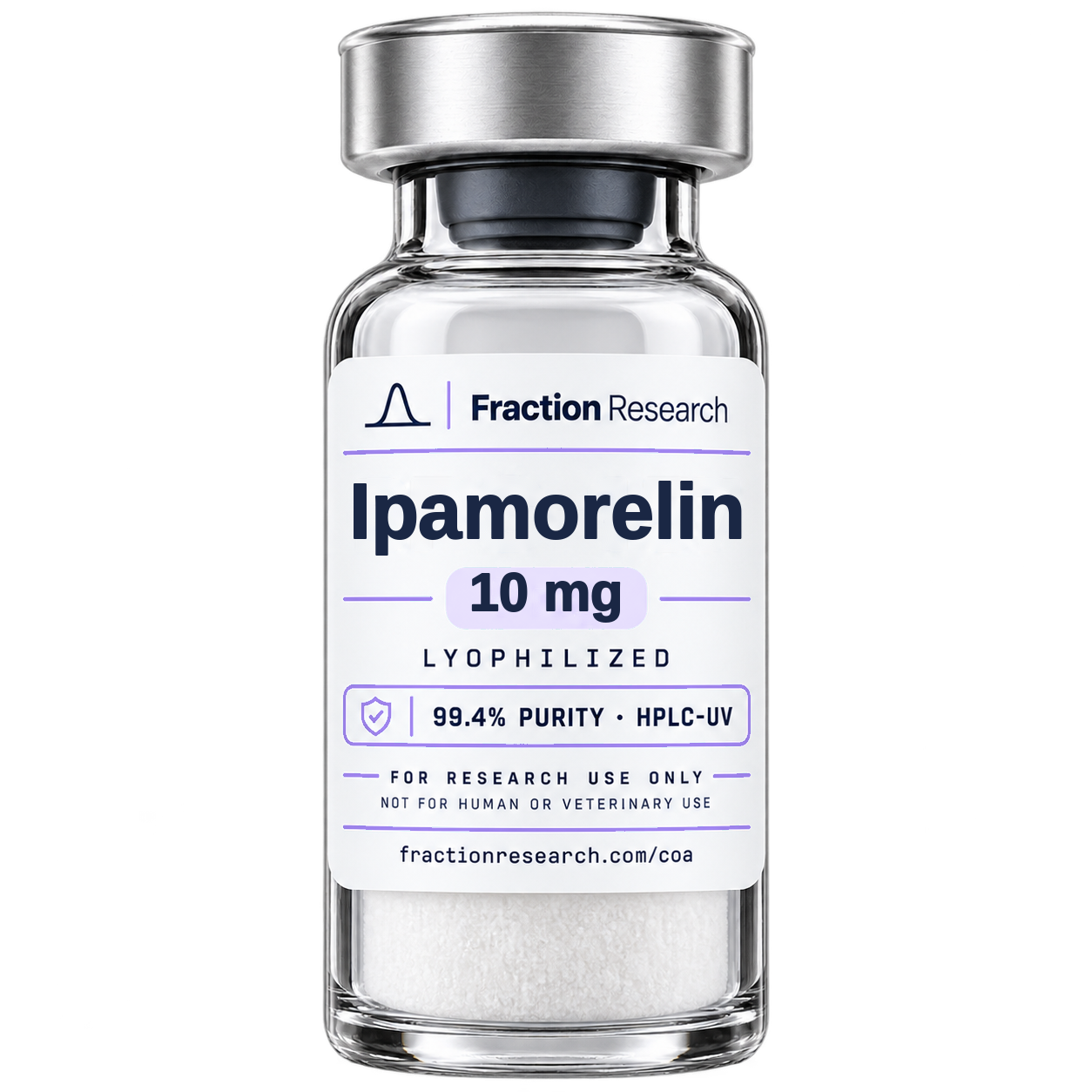
Ipamorelin is a synthetic pentapeptide growth hormone secretagogue acting at the growth hormone secretagogue receptor, the same receptor engaged by endogenous ghrelin. It was developed as part of a structure-activity programme seeking selectivity, and the published literature characterises it specifically as the first selective compound in its class.
Mechanistic context
Earlier growth hormone secretagogues stimulated growth hormone release but also produced measurable increases in cortisol and prolactin, reflecting activity beyond the intended pathway. That lack of selectivity limited their value as experimental tools for isolating growth hormone effects. Ipamorelin was characterised as releasing growth hormone with substantially less effect on those other axes, which is the property that defines it in the literature and the reason it remains a useful research reagent for separating growth hormone-mediated effects from broader neuroendocrine activation.
Published findings
Raun and colleagues (1998) reported the original characterisation of ipamorelin as the first selective growth hormone secretagogue, establishing both potency and the selectivity profile against cortisol and prolactin release. This paper remains the definitive primary reference.
Ankersen and colleagues (1998) described a series of highly potent growth hormone-releasing peptides derived from the ipamorelin scaffold, reporting the medicinal chemistry work around the structure and clarifying which features drive activity.
Johansen and colleagues (1998) reported pharmacokinetic evaluation of ipamorelin and other peptidyl secretagogues with emphasis on nasal absorption, addressing disposition and route rather than efficacy. Jiménez-Reina and colleagues (2002) examined the influence of chronic treatment in young female rats, reporting somatotroph responses assessed in vitro — a design that examines the pituitary cell population itself after in vivo exposure.
Scope and limitations of the evidence
The ipamorelin literature is preclinical, drawn from rodent studies and in vitro pituitary preparations. There is no substantial human clinical literature comparable to that available for CJC-1295 with DAC or tesamorelin. The concentration of the foundational work in 1998, largely from a single pharmaceutical research programme, means the compound is well characterised in its original context but less extensively replicated since.
The chronic treatment work by Jiménez-Reina and colleagues is methodologically useful because it addresses whether repeated stimulation alters somatotroph responsiveness — a question of desensitisation that single-administration studies cannot answer.
Use in experimental design
Growth hormone secretion is pulsatile and strongly influenced by sleep state, feeding, stress and time of day. Any design measuring secretory endpoints requires sampling frequent enough to resolve pulses and careful control of these variables; single time-point measurements are largely uninformative. Where the selectivity property is being exploited, cortisol and prolactin should be measured alongside growth hormone rather than assumed unchanged, since selectivity is relative rather than absolute.
Analytical and handling notes
Each lot is supplied with a certificate of analysis reporting RP-HPLC purity, mass identification by ESI-MS and label claim recovery, together with an independent ICP-MS elemental impurities report. Purity figures apply to the specific lot tested and should be read against the lot documentation rather than inferred from generic reference material. Storage guidance appears on the technical data sheet; the exact supplied salt form, counterion and hydration state are lot and supplier specific and should be reconciled against supplier documentation before quantitative work.
This material is supplied for laboratory research use only. It is not a drug, is not intended for human or veterinary use, and no statement above should be read as a claim of therapeutic effect.