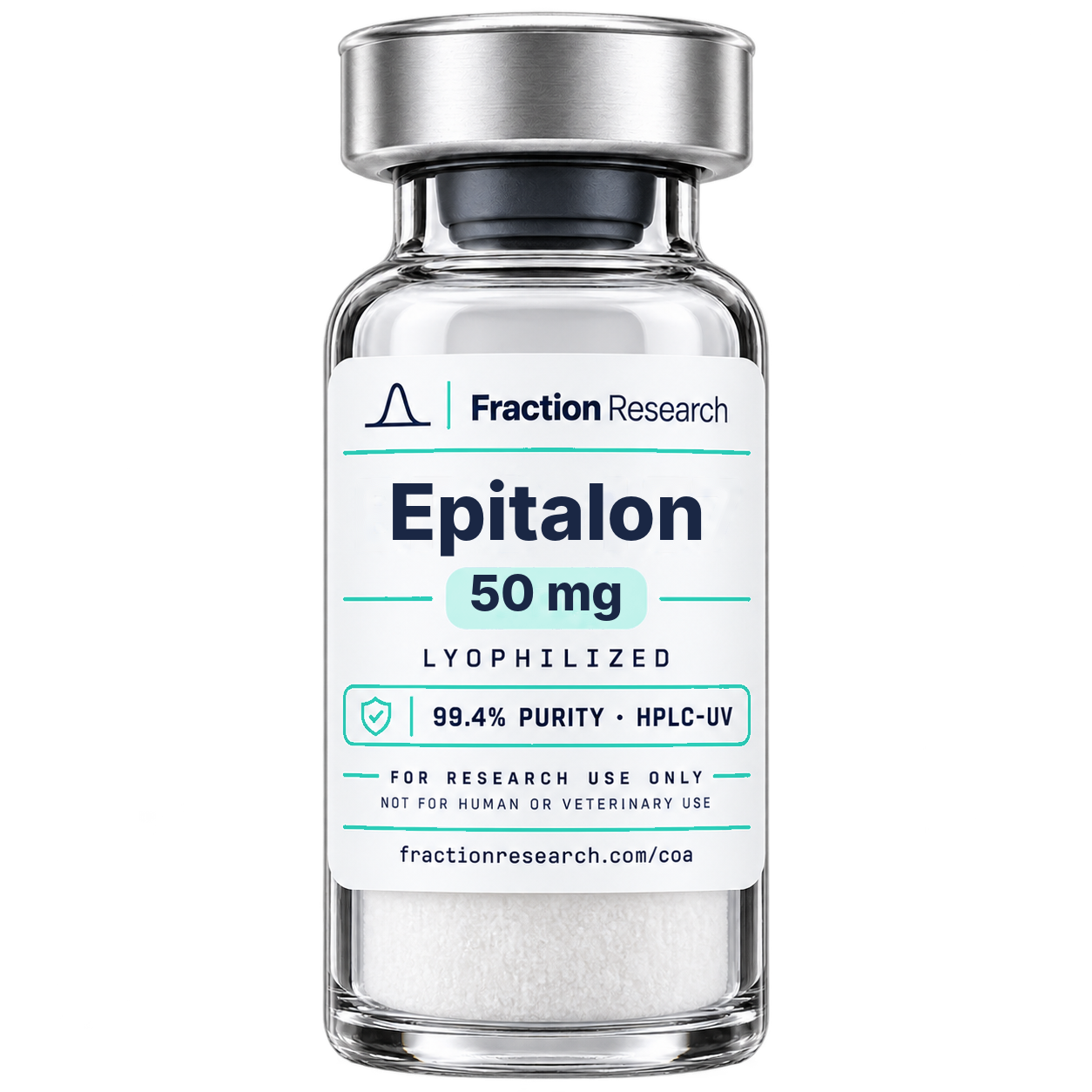
Epithalon, also transliterated as Epitalon in a substantial portion of the literature, is a synthetic tetrapeptide with the sequence Ala-Glu-Asp-Gly. It was developed at the St Petersburg Institute of Bioregulation and Gerontology as a synthetic analogue of epithalamin, a peptide preparation obtained from the pineal gland. Both transliterations appear in indexed literature, and searches under only one spelling will miss part of the record.
Mechanistic context
The published rationale centres on telomerase activity and telomere maintenance. Telomeres shorten with successive somatic cell divisions, and this shortening is a widely studied correlate of replicative senescence. The hypothesis pursued in the Epithalon literature is that the peptide induces telomerase expression in somatic cells, with consequences for replicative capacity. A parallel line of enquiry concerns pineal regulation and neuroendocrine ageing markers.
Published findings
Khavinson and colleagues (2003) reported that the peptide induced telomerase activity and telomere elongation in human somatic cells in culture — the most direct mechanistic claim in this literature and the basis for most subsequent interest. A companion report from the same group (2004) described the peptide promoting the overcoming of the division limit in human somatic cells, extending the telomerase observation to a functional replicative endpoint.
Khavinson and colleagues (2000) examined lifespan effects in Drosophila melanogaster, an invertebrate model widely used in ageing research for its short generation time. Anisimov and colleagues (2003) reported on biomarkers of ageing, lifespan and spontaneous tumour incidence in female Swiss-derived SHR mice, combining longevity endpoints with tumour surveillance.
Scope and limitations of the evidence
Two limitations dominate any assessment of this literature. First, the great majority of the primary work originates from a single institution and a small group of closely associated investigators; independent replication of the telomerase findings by unaffiliated laboratories is limited. Second, much of the work was published in Russian-language journals or in translation, which has historically constrained visibility and peer scrutiny outside that research community.
The Drosophila and mouse longevity work uses established ageing models, but lifespan studies are notoriously sensitive to husbandry conditions, caloric intake and cohort effects. Tumour incidence endpoints in SHR mice carry strain-specific baseline rates that must be accounted for in interpretation.
Use in experimental design
Investigators examining telomerase endpoints should be aware that measurement methodology varies considerably — TRAP assays, qPCR-based telomere length measurement and terminal restriction fragment analysis are not directly comparable, and the original reports do not always permit reconstruction of which was used under what conditions. Where replicative capacity is the endpoint, passage number, seeding density and serum lot all influence results and should be controlled and reported.
Analytical and handling notes
Each lot is supplied with a certificate of analysis reporting RP-HPLC purity, mass identification by ESI-MS and label claim recovery, together with an independent ICP-MS elemental impurities report. Purity figures apply to the specific lot tested and should be read against the lot documentation rather than inferred from generic reference material. Storage guidance appears on the technical data sheet; the exact supplied salt form, counterion and hydration state are lot and supplier specific and should be reconciled against supplier documentation before quantitative work.
This material is supplied for laboratory research use only. It is not a drug, is not intended for human or veterinary use, and no statement above should be read as a claim of therapeutic effect.