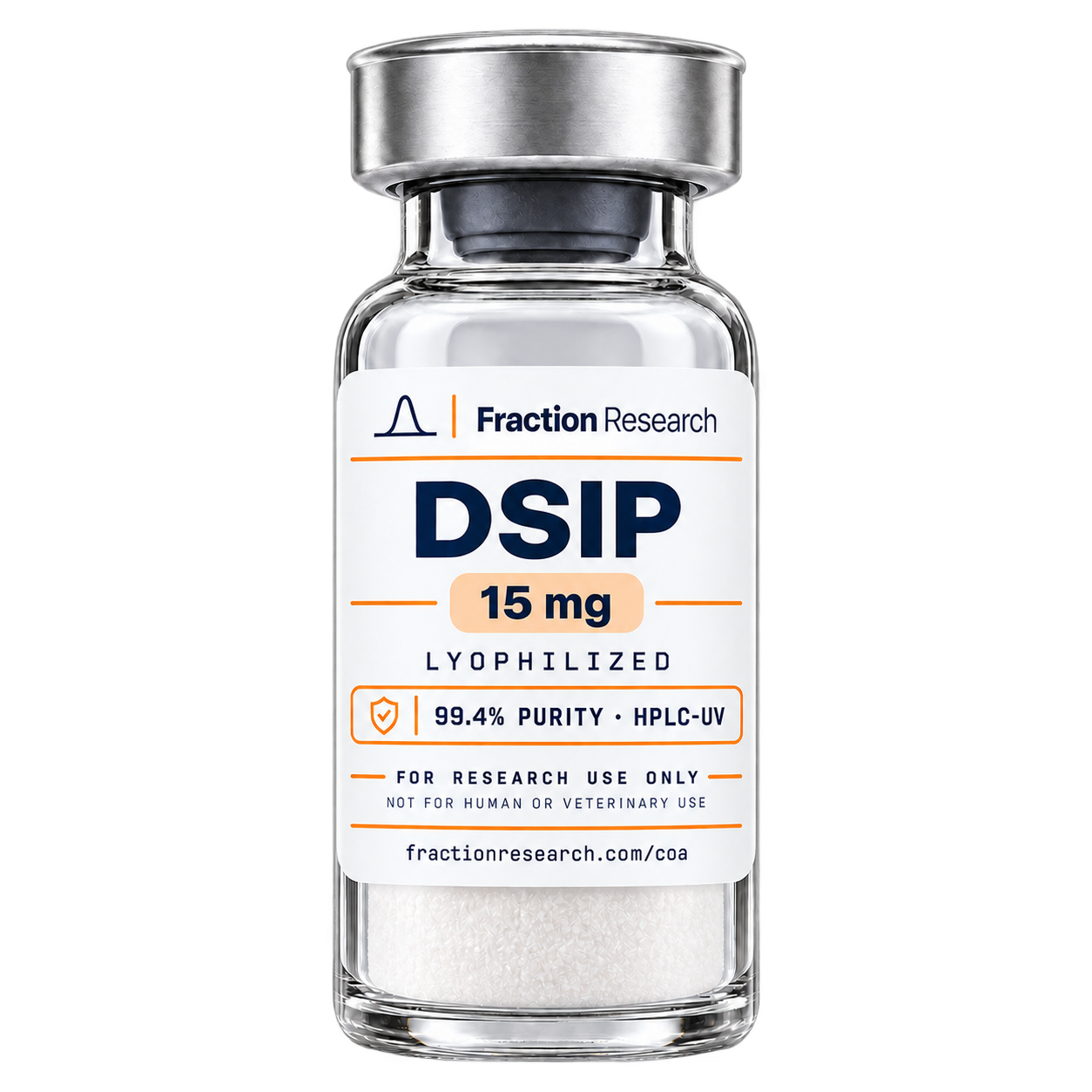
Delta sleep-inducing peptide, generally abbreviated DSIP, is a nonapeptide first isolated from rabbit cerebral venous blood during experiments involving electrical stimulation of the thalamus. Its name derives from the delta-wave EEG activity associated with slow-wave sleep, which the peptide was originally reported to promote. It is among the older compounds in this catalogue, with a primary literature concentrated in the late 1970s through early 1990s.
Mechanistic context
No specific receptor for DSIP has been definitively characterised in the peer-reviewed literature, and this remains the central open question about the peptide. Proposed mechanisms in the published work have included interactions with neurotransmitter systems and modulation of neuroendocrine output, but none has achieved the status of an established pathway. As with BPC-157, investigators should note that secondary sources frequently assert mechanisms that the primary literature does not support.
Published findings
Schoenenberger and colleagues (1978) reported the amino acid analysis, sequence, synthesis and activity of the nonapeptide, establishing the chemical identity of the molecule and its synthetic accessibility. This paper is the foundational reference for the compound.
Schneider-Helmert and Schoenenberger (1981) examined the influence of synthetic DSIP on disturbed human sleep. Schneider-Helmert (1986) reported on efficacy in normalising sleep in middle-aged and elderly chronic insomniacs. Both are human studies, which is notable given how much of this catalogue is preclinical.
Bes and colleagues (1992) conducted a double-blind study of DSIP effects on sleep in chronic insomniac patients — the most methodologically rigorous design among the cited human work, and therefore the one that should carry most weight.
Scope and limitations of the evidence
The human sleep literature on DSIP is small, dated, and drawn from limited samples. The double-blind design by Bes and colleagues is the appropriate reference point for evaluating the compound, and investigators should weight it above the earlier open-label reports. Sleep research methodology has changed substantially since these studies were conducted; polysomnographic scoring criteria, statistical practice and trial reporting standards have all been revised, which complicates direct comparison with contemporary sleep literature.
The absence of a characterised receptor limits mechanistic study design. Without a defined target there is no straightforward way to demonstrate engagement or to construct antagonist controls, and functional endpoints must carry the entire interpretive burden.
Use in experimental design
Sleep endpoints are unusually sensitive to environmental and procedural variables — light exposure, ambient temperature, handling, and circadian timing of administration all affect outcomes in both animal and human protocols. Studies drawing on this literature should document these conditions explicitly, since the original reports often predate current reporting conventions and do not always specify them. Where EEG endpoints are used, scoring methodology should be stated, as delta-power quantification methods have changed considerably since the foundational work.
Analytical and handling notes
Each lot is supplied with a certificate of analysis reporting RP-HPLC purity, mass identification by ESI-MS and label claim recovery, together with an independent ICP-MS elemental impurities report. Purity figures apply to the specific lot tested and should be read against the lot documentation rather than inferred from generic reference material. Storage guidance appears on the technical data sheet; the exact supplied salt form, counterion and hydration state are lot and supplier specific and should be reconciled against supplier documentation before quantitative work.
This material is supplied for laboratory research use only. It is not a drug, is not intended for human or veterinary use, and no statement above should be read as a claim of therapeutic effect.