Copper & Dermal Peptides

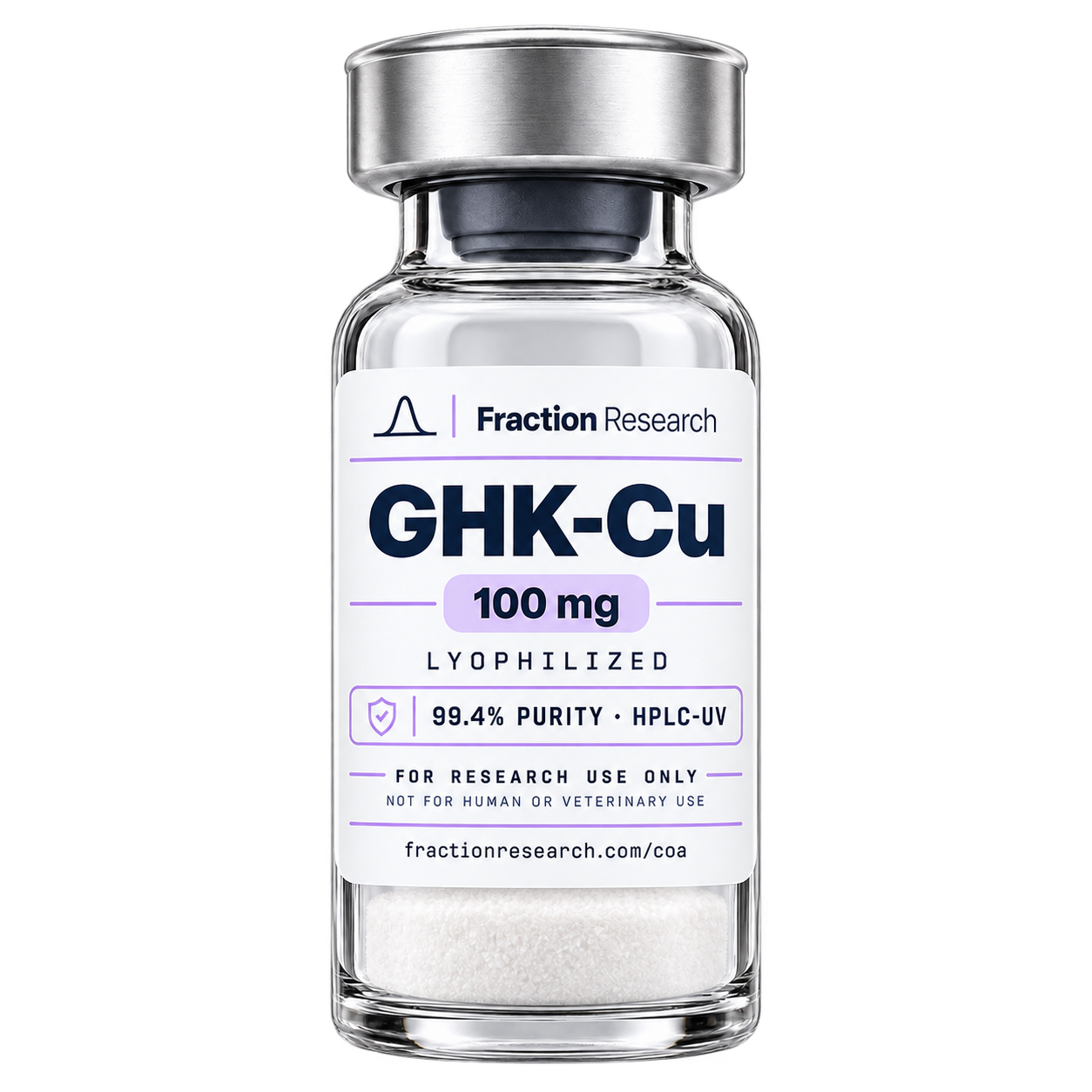
GHK-Cu

Price range: $39.99 through $54.99

Current Lot WWB-CU100-4385 verified Mar 5, 2026

Copper peptide complex

CAS Number
49557-75-7
Molecular Formula
C₁₄H₂₄CuN₆O₄
Molecular Weight
403.91 g/mol
Form
Salt form
Purity
≥99.2% by HPLC-UV
Cold-Packed Protected seasonal packaging
Dispatches ≤48hr From Columbia, SC
Lot Verified COA included with every order
Independently Tested HPLC-UV verified, every single lot
Lot-traceable — matched to a public Certificate of Analysis
Research Use Only — not for human or veterinary use
View Certificate of Analysis

What You Receive

1× Research Vial
  • GHK-Cu — nominal content per selected size
  • Salt form
  • Tamper-evident seal
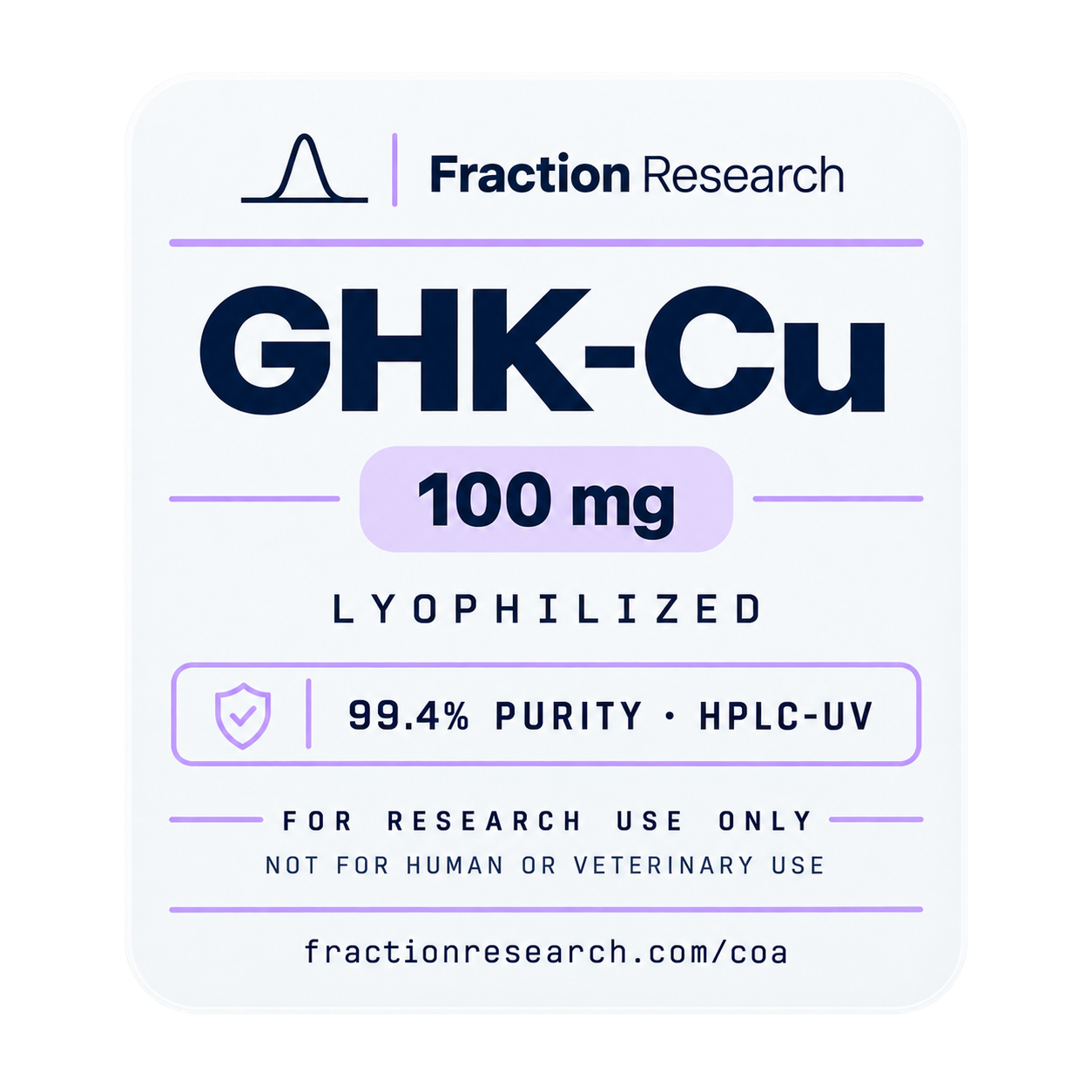
  • Lot-numbered label
  • Lot-matched Certificate of Analysis
Verification

Current Lot & Certificate of Analysis

Lot NumberWWB-CU100-4385
HPLC Purity98.83%
Test DateMar 5, 2026
Testing LaboratoryJanoshik Analytical
Analytical MethodHPLC-UV, 218nm
LC-MS IdentityConfirmed
Specifications

Technical Specifications

CAS Number 49557-75-7
Molecular Formula C₁₄H₂₄CuN₆O₄
Molecular Weight 403.91 g/mol
Physical Form Salt form
Purity Specification ≥99.2% by HPLC-UV
Analytical Method HPLC-UV, 218nm
Appearance Lyophilized copper-peptide research material
Storage Conditions Store sealed, protected from moisture and light; minimize temperature cycling
Lot Number WWB-CU100-4385
Batch / Test Date Mar 5, 2026
Research Context

Research Overview

GHK-Cu is a copper peptide complex formed between the tripeptide glycyl-L-histidyl-L-lysine and a copper(II) ion. It is not a peptide alone but a defined metal-peptide complex, and the copper is integral to the activity described in the literature rather than incidental to it. The tripeptide was originally identified in human plasma, with subsequent work establishing its high affinity for copper(II).

Mechanistic context

The published mechanistic work concerns extracellular matrix biology. GHK-Cu has been studied for effects on collagen synthesis, glycosaminoglycan production and matrix metalloproteinase expression in fibroblast systems — that is, on both the synthesis and the controlled degradation arms of matrix turnover. The copper ion is understood in this literature to be functionally necessary, and the complex is generally studied as such rather than as the free tripeptide.

Published findings

Maquart and colleagues (1988) reported stimulation of collagen synthesis in fibroblast cultures by the tripeptide-copper complex, establishing the principal finding on which subsequent work builds. Wegrowski and colleagues (1992) extended this to sulfated glycosaminoglycan synthesis, broadening the matrix synthesis picture beyond collagen alone.

Siméon and colleagues (2000) reported that the complex stimulated matrix metalloproteinase-2 expression in fibroblast cultures. This is an important counterpoint to the synthesis findings: it indicates effects on matrix remodelling in both directions, which is a more nuanced picture than synthesis stimulation alone.

Pollard and colleagues (2005) examined effects on the growth and expression of growth factors by normal and irradiated fibroblasts, introducing a stressed-cell comparison alongside normal cells.

Scope and limitations of the evidence

This literature is predominantly in vitro, conducted in cultured fibroblast systems. Fibroblasts in culture behave differently from fibroblasts in intact tissue — they lack the three-dimensional matrix context, the mechanical loading and the immune cell interactions that shape matrix turnover in vivo — and results should not be extrapolated across that gap without caution.

A specific analytical consideration applies to this compound that does not apply to the peptides in this catalogue. Because activity depends on the copper complex, both the peptide identity and the copper stoichiometry are relevant to experimental interpretation. Free copper ions have biological effects of their own, and study designs should distinguish complex-mediated effects from those attributable to copper alone, ideally with appropriate copper-salt controls.

Use in experimental design

Copper speciation in culture medium is affected by medium composition, serum content and pH, all of which influence the stability of the complex. These conditions should be documented. Where matrix endpoints are measured, the distinction between transcript-level and protein-level measurement matters, since the cited literature includes both and they do not always agree.

Analytical and handling notes

Each lot is supplied with a certificate of analysis reporting RP-HPLC purity, mass identification and label claim recovery, together with an independent ICP-MS elemental impurities report. The elemental report is of particular relevance for a copper complex, since it characterises the elemental impurity profile against ICH Q3D limits — noting that the copper present as part of the intended complex is a constituent of the material rather than an impurity. Storage guidance appears on the technical data sheet, which describes this material as a lyophilised copper-peptide research material.

This material is supplied for laboratory research use only. It is not a drug, is not intended for human or veterinary use, and no statement above should be read as a claim of therapeutic effect.


References

  1. Maquart FX, Pickart L, Laurent M, Gillery P, Monboisse JC, Borel JP. Stimulation of collagen synthesis in fibroblast cultures by the tripeptide-copper complex glycyl-L-histidyl-L-lysine-Cu2+. FEBS Lett. 1988;238(2):343-346. doi:10.1016/0014-5793(88)80509-X.
  2. Wegrowski Y, Maquart FX, Borel JP. Stimulation of sulfated glycosaminoglycan synthesis by the tripeptide-copper complex glycyl-L-histidyl-L-lysine-Cu2+. Life Sci. 1992;51(13):1049-1056. doi:10.1016/0024-3205(92)90504-I.
  3. Siméon A, Emonard H, Hornebeck W, Maquart FX. The tripeptide-copper complex glycyl-L-histidyl-L-lysine-Cu2+ stimulates matrix metalloproteinase-2 expression by fibroblast cultures. Life Sci. 2000;67(18):2257-2265. doi:10.1016/S0024-3205(00)00803-1.
  4. Pollard JD, Quan S, Kang T, Koch RJ. Effects of copper tripeptide on the growth and expression of growth factors by normal and irradiated fibroblasts. Arch Facial Plast Surg. 2005;7(1):27-31. doi:10.1001/archfaci.7.1.27.

Citations are provided for research context only. They describe published work on this compound and are not claims about this product.

Fulfillment

Fulfillment & Packaging

Ships From

Columbia, South Carolina

Dispatch Timeframe

Within 48 hours of order confirmation

Cold-Chain Packaging

Insulated, seasonally adjusted packaging protects material in transit

Tamper-Evident Vial

Every vial ships sealed and lot-labeled

Shipping Area

Domestic (U.S.) shipping only

Shipping Cost

Calculated at checkout — see the Shipping Policy for full details

Questions

Frequently Asked Questions

Is this lot independently tested?

Yes. Every lot is tested by an independent third-party laboratory using HPLC-UV before it is released for sale, and results are published in the COA Library.

How do I locate my lot's Certificate of Analysis?

Use the "View Certificate of Analysis" link on this page, or search the COA Library directly by compound name or the lot number printed on your vial label.

What analytical methods are used?

Purity is determined by HPLC-UV. Molecular identity is confirmed by LC-MS prior to release.

How is the material packaged?

Material ships in a tamper-evident, lot-labeled vial inside cold-chain packaging appropriate for the season.

What does "Research Use Only" mean?

This product is sold exclusively for laboratory and in-vitro research applications by qualified researchers. It is not a drug, dietary supplement, or approved for human or veterinary use.