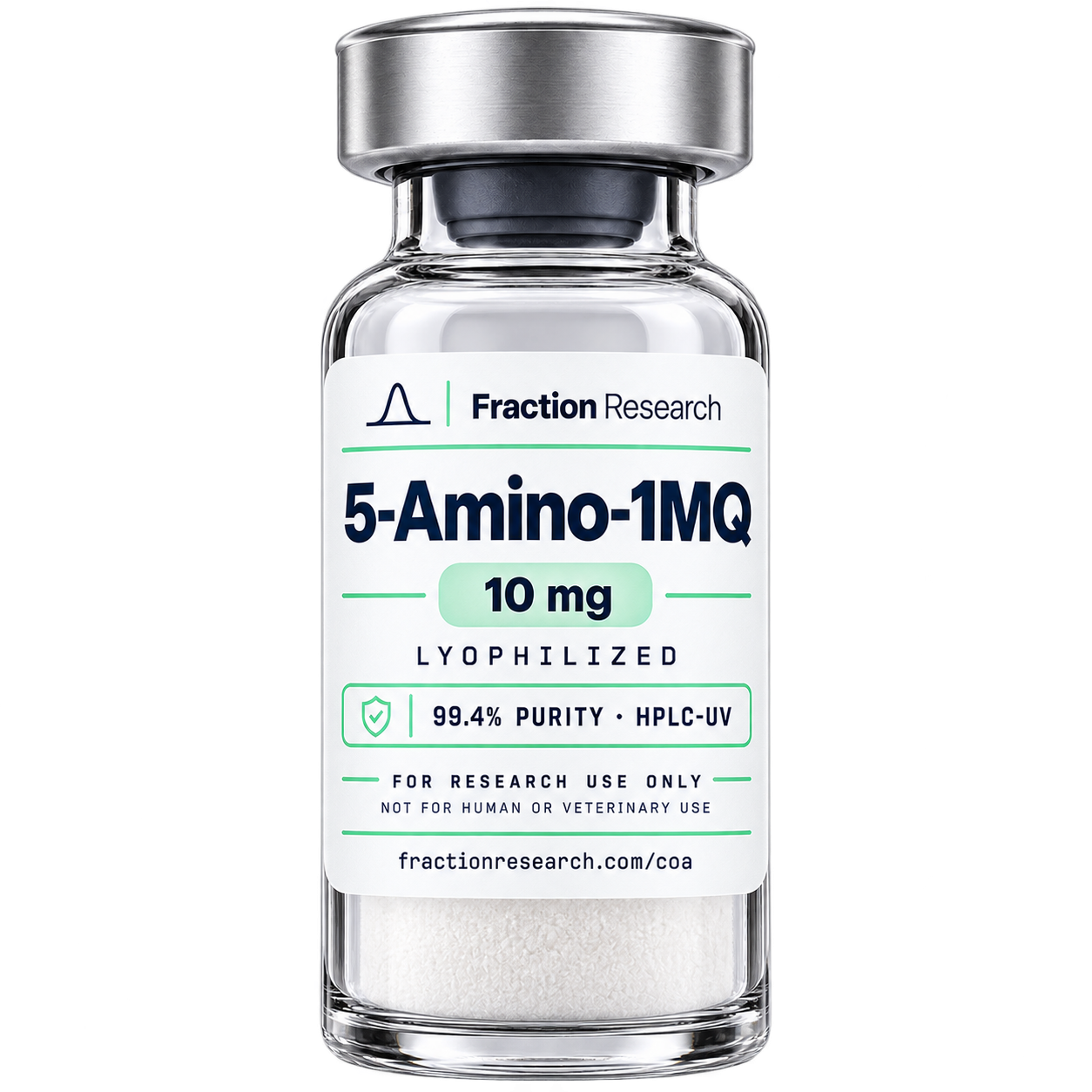
5-Amino-1MQ is a small-molecule quinolinium compound investigated as a selective inhibitor of nicotinamide N-methyltransferase (NNMT). It is not a peptide. NNMT catalyses the transfer of a methyl group from S-adenosylmethionine to nicotinamide, producing 1-methylnicotinamide and consuming methyl donor capacity in the process. Because NNMT sits at a junction between nicotinamide salvage, NAD+ availability and cellular methylation potential, it has attracted attention as a metabolic regulatory node, particularly in adipose tissue and skeletal muscle where its expression varies with nutritional state.
Mechanistic context
Interest in NNMT inhibition follows from observations that enzyme expression is elevated in adipose tissue under conditions of nutritional excess in rodent models. The working hypothesis in the published literature is that reducing NNMT activity preserves intracellular nicotinamide for NAD+ synthesis and alters the methyl donor balance, with downstream consequences for energy expenditure in adipocytes. 5-Amino-1MQ was developed as a membrane-permeable inhibitor, a property that distinguishes it from earlier NNMT inhibitors whose utility was limited by poor cellular access.
Published findings
Neelakantan and colleagues (2018) reported that membrane-permeable small-molecule NNMT inhibitors reversed diet-induced obesity phenotypes in mice maintained on a high-fat diet, and characterised the compound class in cellular systems. A subsequent 2019 report from the same group examined effects on senescent muscle stem cells and regenerative capacity in aged mouse skeletal muscle, extending the enquiry from adipose metabolism to muscle biology.
Pharmacokinetic characterisation followed. Awosemo and colleagues (2021) developed and validated an LC-MS/MS assay for 5-amino-1-methylquinolinium in rat plasma and applied it to pharmacokinetic and oral bioavailability studies — work concerned with analytical method development and disposition rather than efficacy. More recently, Babula and colleagues (2024) reported on NNMT inhibition in the context of obesity-related metabolic dysfunction.
Scope and limitations of the evidence
The published record for 5-Amino-1MQ is preclinical. The findings summarised above derive from rodent models and cell culture systems, and a substantial portion originates from a single research group, which is a relevant consideration when weighing independent replication. No clinical trial literature establishes effects in humans, and the pharmacokinetic work characterises disposition in rats rather than people. Investigators designing experiments should treat the compound as a research tool for interrogating NNMT biology rather than as an agent with an established physiological profile.
A further methodological point: because NNMT inhibition alters methyl donor availability, experimental designs examining metabolic endpoints may benefit from controlling for one-carbon metabolism variables that are not always reported in the primary literature.
Use in experimental design
Within the published literature the compound functions primarily as a pharmacological probe for NNMT-dependent processes. Investigators using it in that capacity typically pair inhibition with direct measurement of the enzymatic readouts — 1-methylnicotinamide levels, NAD+ pools, or NNMT expression — rather than inferring target engagement from downstream phenotype alone, since metabolic endpoints in adipose and muscle tissue are influenced by many variables unrelated to methyltransferase activity.
Because 5-Amino-1MQ is a small molecule rather than a peptide, its handling characteristics differ from most of the compounds in this catalogue. Solubility behaviour, stability in solution and compatibility with common vehicles are not standardised in the technical data sheet and should be established empirically for the intended assay system. Comparability across experiments depends on documenting these conditions, as does any attempt to reconcile results with the published record, where vehicle and route differ between studies.
Analytical and handling notes
Each lot supplied is accompanied by a certificate of analysis reporting RP-HPLC purity, mass confirmation and label claim recovery, together with an independent ICP-MS elemental impurities report. Purity figures apply to the specific lot tested and should be read alongside the lot-specific documentation rather than inferred from generic reference material. Storage guidance is given on the technical data sheet; the exact supplied salt form, counterion and hydration state are lot and supplier specific and should be reconciled against supplier documentation before use in quantitative work.
This material is supplied for laboratory research use only. It is not a drug, is not intended for human or veterinary use, and no statement above should be read as a claim of therapeutic effect.